
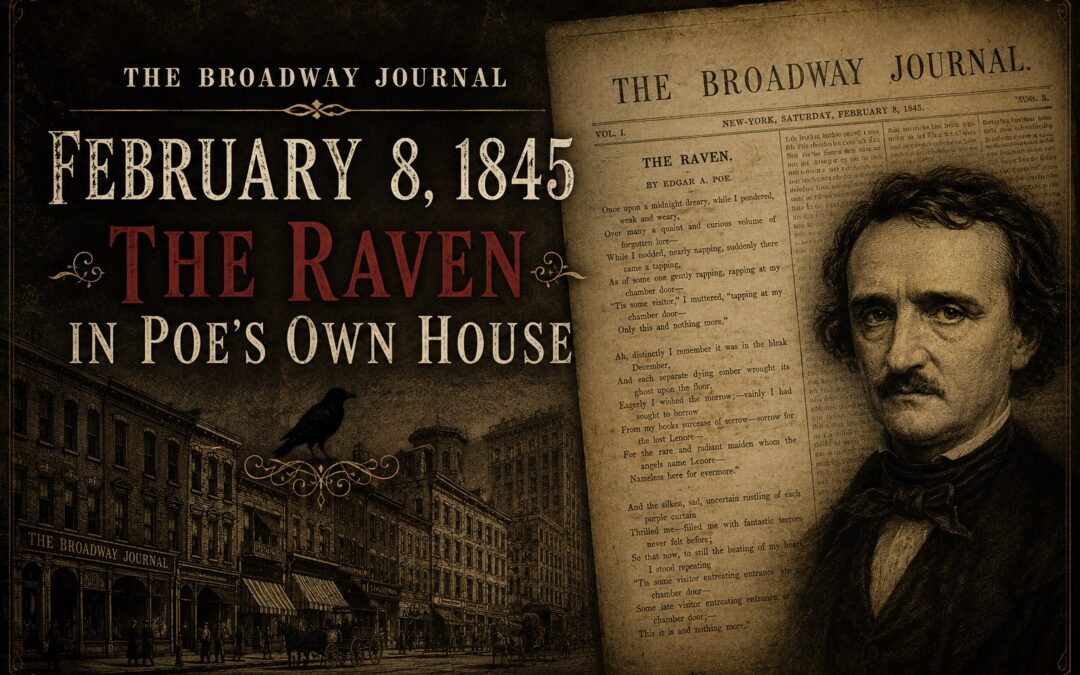
On January 29, 1845, “The Raven” appeared in the New York Evening Mirror under Poe’s name, introduced by Nathaniel Parker Willis as something altogether new in American verse. Nine days later, it ran again — this time in a journal Poe helped edit, on his own terms, under his own roof. “The Raven” appeared in the Broadway Journal on February 8, 1845 — Vol. I, No. 6 — on page 90, under the heading “Original Poetry,” signed Edgar A. Poe.
The February 8, 1845 issue of the Broadway Journal is where Edgar Allan Poe reprinted his most famous poem for the third time in ten days. The second reprinting had run simultaneously in the American Review under the pseudonym “Quarles.” This one was different. The Broadway Journal was Poe’s instrument. Publishing there — and naming himself — was an act of ownership.
A Journal Six Issues Old
The Broadway Journal had been running for exactly six weeks when this issue went to press. Founded in January 1845 by Charles F. Briggs, with Poe joining as a co-editor almost immediately, it was a weekly literary paper aimed squarely at New York’s cultural establishment. Poe used it as a platform, a pulpit, and eventually a weapon — reviewing books, settling scores, and championing American writers he believed were being ignored. By the time this issue appeared, he had already published reviews of Longfellow, Elizabeth Barrett Browning, and R. H. Horne in its pages.
By the time this issue reached readers, “The Raven” was already spreading faster than anyone had anticipated. The Alexandria Gazette had run a full reprint on the same day — February 8 — sourced from the American Review, crediting Poe by name. Within weeks it would appear in Vermont, West Virginia, Arkansas, Ohio, Indiana. The poem was moving across the country through newspaper exchanges while Poe watched from his editorial desk on Broadway.
The Issue Itself
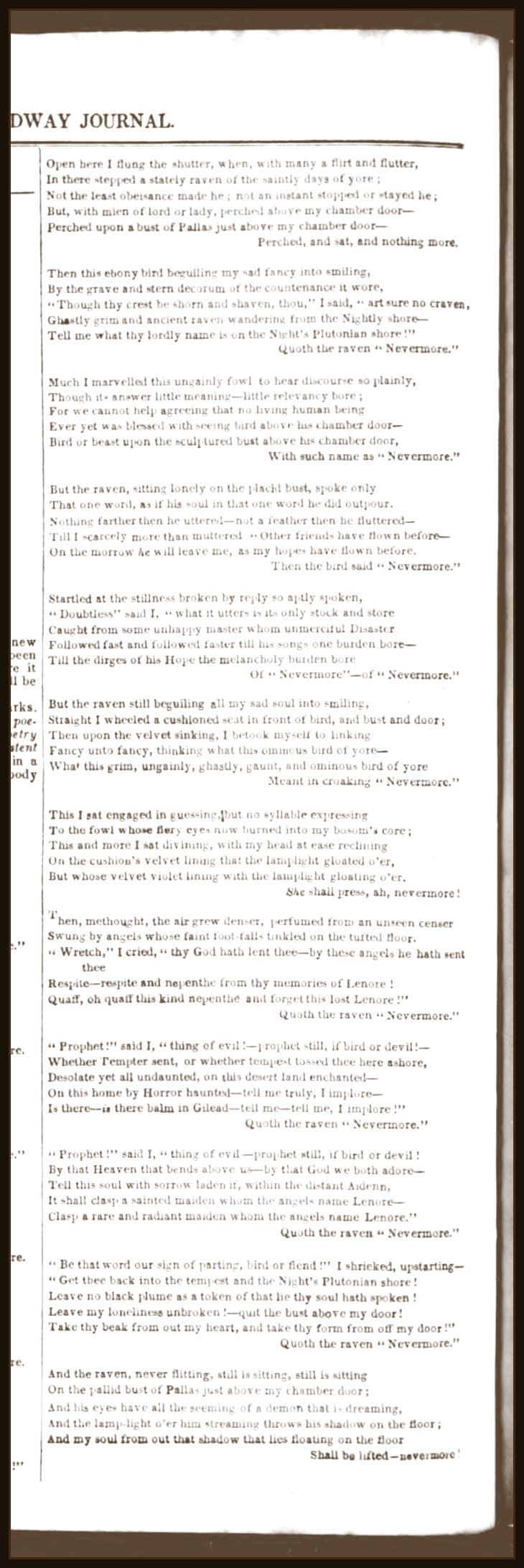
Sixteen pages, printed in double columns on letterpress stock. The Internet Archive scan of this issue — identifier sim_broadway-journal_1845-02-08_1_6 — runs 8.8 MB and reproduces the full issue at readable resolution. Page 90 is the tenth page of this issue and carries the running header “THE BROADWAY JOURNAL.” at the top. “The Raven” appears under the section heading “Original Poetry.” The left column of the same page runs “The Two Paths,” an unrelated verse, alongside the editorial introduction that precedes the poem.
There is no independent editorial note attached to the poem itself. The poem stands alone — stanza breaks preserved, the rising refrain of “Nevermore” given its full weight on the page — formatted with the same care as the Evening Mirror printing nine days earlier. The only attribution: “Edgar A. Poe” at the foot of the poem.
The Editorial Introduction
The left column of page 90 carries something worth reading carefully. Before printing the poem, the Broadway Journal ran a short editorial introduction. It reads, in full:
“WE copy the following poem from the American Review, the new Whig Magazine, on account of its unusual beauty. It will have been read by many of our city subscribers, we have no doubt, before it reaches them in our columns, but there are others to whom it will be as welcome as it is new. Mr. Willis copies it into the Mirror with the following remarks, ‘In our opinion it is the most effective single example of fugitive poetry ever published in this country; and unsurpassed in English poetry for subtle conception, masterly [mastery] of versification and consistent sustaining of imaginative lift. It is one of those dainties bred in a book, which we feed on. It will stick to the memory of everybody who reads it.'”
— The Broadway Journal, February 8, 1845, page 90
Three things stand out. First, the journal says outright that it is copying the poem from the American Review — not publishing it as a new submission. Poe was co-editor and this was his decision. Second, the editorial calls the poem’s beauty “unusual” before any critical apparatus — a plain judgment, not a promotional frame. Third, they quote Willis’s praise from the Mirror without argument or qualification, giving it institutional weight. The Broadway Journal is essentially endorsing the endorsement.
What the editorial does not say is that the poet and the co-editor are the same person. “Edgar A. Poe” appears only under the poem’s title — “THE RAVEN. BY EDGAR A. POE.” — printed in the left column below the introduction. That pairing, the editorial voice saying “we copy” and then the attribution line naming Poe, is the meaningful act. The American Review printing had carried it anonymously under the pseudonym “Quarles.” The American Review printing carried it anonymously. Here, in a journal Poe helped run, it carried his name. That was the point.
The Instrument
Poe’s editorial relationship with the Broadway Journal escalated quickly. By summer 1845, he had bought out Briggs’s share and become sole proprietor. He used that position to do something that occupied him for years: reprinting his own earlier work, revised, in a venue he controlled. The Broadway Journal became the first place where revised versions of stories like “Berenice,” “Ligeia,” and “The Fall of the House of Usher” appeared — the texts that would anchor his posthumous reputation. The Broadway Journal also became his primary venue for literary criticism, where he developed the positions that would later crystallize in “The Philosophy of Composition.”
The journal folded in January 1846. Poe had run it for less than a year as sole owner. The costs of printing, combined with his deteriorating health and finances, made continuation impossible. He walked away from the Broadway Journal with almost nothing — 52 issues, a body of criticism, and the revised texts of his best stories.
After the Journal
Three months after the Broadway Journal closed, Poe published “The Philosophy of Composition” in Graham’s Magazine — April 1846. That essay presented “The Raven” as a cold exercise in calculation: a poem built backward from its desired effect, every element chosen by logic rather than inspiration. It is one of the most influential pieces of literary criticism in American letters, and it was written by a man who no longer had a journal to publish it in.
The February 8, 1845 issue of the Broadway Journal sits at the midpoint of that arc. “The Raven” had just exploded into the national press. The editorial introduction in the left column of page 90 called it “unusual beauty.” Willis had called it “the most effective single example of fugitive poetry ever published in this country.” Poe had a platform, a byline, and the momentum of the most-talked-about poem in the country. Fourteen months later, the journal was gone and the poem had already left him behind.
The scan is on Internet Archive. Page 90 is still legible. The refrain is still there, at the foot of page 90, exactly as he set it.
Frequently Asked Questions
On what page does “The Raven” appear in the Broadway Journal?
“The Raven” appears on page 90 of the Broadway Journal — the running page number printed at the top of the page, which is the tenth of sixteen pages in Vol. I, No. 6. It appears under the section heading “Original Poetry,” signed “Edgar A. Poe.” The left column of the same page carries the editorial introduction and “The Two Paths,” an unrelated poem.
Why did Poe reprint “The Raven” in the Broadway Journal?
Poe co-edited the Broadway Journal from its founding in January 1845. The journal’s own editorial introduction says it was “copied” from the American Review “on account of its unusual beauty” — but the decision to copy it, and to name Poe as author, was Poe’s own. The American Review printing had run it anonymously under the pseudonym “Quarles.” Publishing it under his full name in a journal he co-edited was an act of authorial ownership.
Is the February 8, 1845 Broadway Journal available online?
Yes. The Internet Archive holds a full scan under the identifier sim_broadway-journal_1845-02-08_1_6. The scan runs 8.8 MB and reproduces all 16 pages at readable resolution. Page 90 — the page containing “The Raven” — is the tenth page of the scan.
What did the Broadway Journal say about “The Raven” when it reprinted it?
The journal’s editorial introduction called the poem of “unusual beauty” and quoted Nathaniel Parker Willis’s praise from the New York Evening Mirror — describing it as “the most effective single example of fugitive poetry ever published in this country” and “unsurpassed in English poetry for subtle conception, masterly [mastery] of versification.” The introduction appeared on page 90, in the left column directly above the poem.
The scan is on Internet Archive. Page 90 is still legible. For more primary source documents tracing “The Raven”‘s 1845 publication history, see the Evening Mirror first appearance, the American Review printing, and Poe’s own retrospective in “The Philosophy of Composition.”
Source document: Broadway Journal, Vol. I, No. 6 — February 8, 1845 — Internet Archive (public domain). Download PDF.