
Primary Source Analysis: Poe’s 1839 Book Advertisement
Document Overview
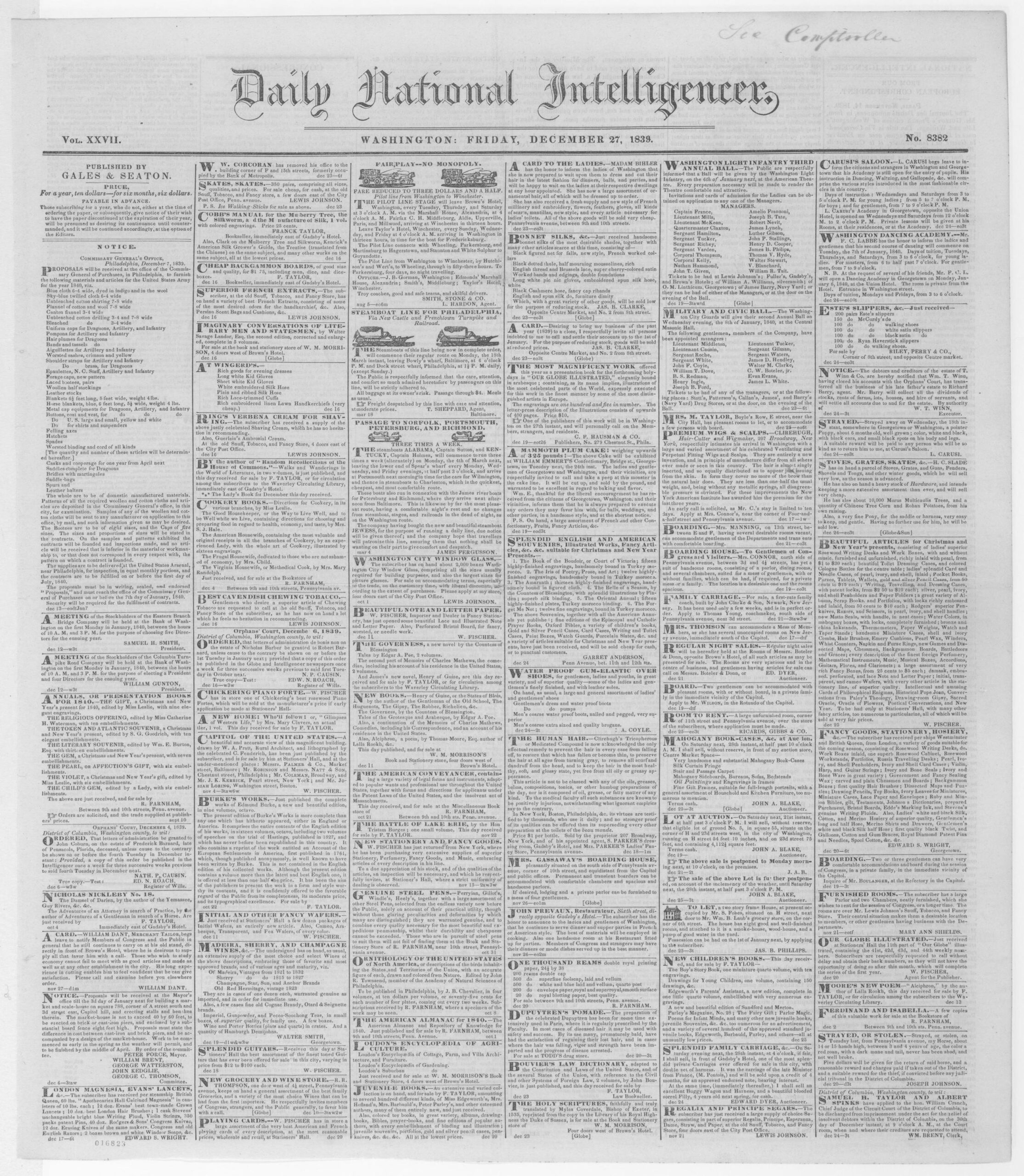
This is the front page of the Daily National Intelligencer (Washington, D.C.), Vol. XXVII, No. 8382, published on Friday, December 27, 1839. Among its columns of political news, shipping reports, and social notices, this edition carries something of quiet literary significance: a bookseller’s advertisement for Edgar Allan Poe‘s debut short story collection, Tales of the Grotesque and Arabesque, published just weeks earlier by Lea and Blanchard of Philadelphia. The advertisement appears alongside listings for works by the Countess of Blessington and Thomas Moore, offered for sale at W. M. Morrison’s bookshop and F. Taylor’s bookshop in Washington. The page is held in the Library of Congress digital newspaper archive and can be viewed in full here Chronicling America.
Publication Details
The Daily National Intelligencer was founded in 1813 and published in Washington City until 1869 by the firm of Gales & Seaton. By 1839 it was among the most established and widely read newspapers in the federal capital, with strong ties to the Whig political establishment and a readership that extended to Congress, the diplomatic corps, and educated households throughout the Mid-Atlantic. Its four-page format mixed national political coverage with commercial advertising, literary notices, and foreign intelligence — making it a natural venue in which a Philadelphia publisher might place an announcement directed at the city’s literate, book-buying public.
The booksellers named in the advertisement — W. M. Morrison and F. Taylor — were among Washington’s established retail book trade, routinely stocking new releases from the major Philadelphia and New York publishing houses and advertising their wares in the Intelligencer‘s columns. That Tales of the Grotesque and Arabesque appeared alongside works by the popular Anglo-Irish society novelist the Countess of Blessington and the beloved Irish poet Thomas Moore speaks to the commercial ambitions of the collection: Lea and Blanchard were positioning it within the respectable literary marketplace of the day, not as a curiosity, but as a volume fit for the same shelves as fashionable British imports.
Content Summary
The advertisement announces the availability of Tales of the Grotesque and Arabesque, Poe’s first substantial collection of prose fiction, issued in two octavo volumes. The collection brought together twenty-five tales, all but one of which had previously appeared in periodicals. Volume I contained, among others:
- “The Fall of the House of Usher” — first published in Burton’s Gentleman’s Magazine, September 1839
- “Ligeia” — first published in the American Museum, September 1838
- “Morella” — first published in the Southern Literary Messenger, April 1835
- “William Wilson” — first published in The Gift annual, 1839
- “MS. Found in a Bottle” — first published in the Baltimore Saturday Visiter, October 1833, where it won a prize
- “Shadow. A Fable” and “King Pest”, among others
Volume II included “Berenice”, “Metzengerstein”, “Hans Phaall”, “The Visionary” (later retitled “The Assignation”), and “The Conversation of Eiros and Charmion”, along with an Appendix concerning the science of lunar travel. The collection also featured a brief Preface in which Poe directly addressed critics who might object to its prevailing tone of terror and the grotesque — a defensive gesture that itself reveals the precariousness of his literary position in 1839.
Historical Context
When this advertisement appeared in the Daily National Intelligencer, Edgar Allan Poe was thirty years old and living in Philadelphia, where he had been working since mid-1839 as an assistant editor at Burton’s Gentleman’s Magazine — the same publication in which “The Fall of the House of Usher” had debuted just three months earlier. He was earning approximately ten dollars a week. The terms he had secured with Lea and Blanchard were bleak even by the standards of the struggling antebellum literary marketplace: in a letter dated September 28, 1839 (now held in the Boston Public Library), the publishers agreed to print a small edition of 750 copies, retaining the commercial risk entirely for themselves. Poe received no royalties — only twenty author copies for his own distribution. The copyright remained nominally with Poe, but the financial benefit did not.
The collection was dedicated to Colonel William Drayton of Philadelphia, a distinguished lawyer, former congressman, and patron of the arts who had befriended Poe during his years in the city. The dedication was a strategic as well as personal gesture: association with a figure of Drayton’s social standing lent the collection a veneer of respectability that might help overcome the suspicion with which tales of horror and the macabre were sometimes received by the genteel reading public.
The book received a mixed press. Early notices in the United States Gazette and the Pennsylvania Inquirer (both December 5, 1839) were largely favorable, and the New-York Mirror carried a laudatory short review on December 28, 1839 — the day after this advertisement ran. The Boston Notion, however, published a scathing attack in its December 14 issue. Commercially, the collection never recovered its printing costs. The years that followed — marked by the severe economic depression of 1840–1844 — were not kind to American book sales, and Tales of the Grotesque and Arabesque quietly stalled. Poe would not publish another collection until Tales in 1845, by which point the overnight fame brought by “The Raven” in the New York Evening Mirror and its concurrent appearance in the American Review had transformed his public standing entirely.
Relationship to Other Documents
This advertisement belongs to a network of print evidence that traces Poe’s slow emergence from the Philadelphia magazine world of the late 1830s into the broader national literary consciousness of the 1840s. In the months surrounding this publication, Poe was simultaneously building the editorial connections that would later define his New York years. His complex professional relationship with Nathaniel Parker Willis — explored in depth through a 1842 letter from Willis to Poe and through the wider story of Poe’s editorial authority and the New York literary press — would prove crucial to the reception of “The Raven” in 1845 and to Poe’s posthumous reputation alike.
The stories advertised here in December 1839 would later be reprinted, anthologized, and critically reassessed across subsequent decades. Poe himself annotated his own copy of Volume I in 1842, intending revisions for a new edition that never materialized; that marked-up copy is now held in a private collection. The tales collected in this volume — above all “The Fall of the House of Usher” and “Ligeia” — would anchor Poe’s reputation as the architect of American Gothic fiction long after his death in 1849, and their influence can be traced through later aesthetic movements that extend even into the advertising and visual culture of the Victorian period, as seen in Poe’s shadow over a Victorian advertisement.
Archival Value
As a primary document, this front page of the Daily National Intelligencer for December 27, 1839 provides direct evidence of the book trade infrastructure through which Poe’s debut collection reached the reading public of the nation’s capital. It documents the specific retail channels — Morrison’s and Taylor’s bookshops — through which Washington readers would have encountered Tales of the Grotesque and Arabesque in the weeks following its Philadelphia publication. It places Poe’s work in the commercial company of fashionable British literary figures, revealing how his publishers sought to market the collection to a broad, socially mixed readership rather than a specialist one. And it does so in the pages of a newspaper that was itself a document of record for Washington’s political and professional class — the kind of audience whose endorsement of Poe’s work would have mattered enormously to a writer who was, at that moment, still fighting to be taken seriously.
The survival of this issue in the Library of Congress’s Chronicling America archive makes it freely and publicly accessible, a rare circumstance for a document of this age and specificity. It is a reminder that the history of American literature is preserved not only in bound volumes and manuscripts, but in the everyday ephemera of newspaper columns — in the small advertisements that appeared between shipping reports and congressional proceedings, announcing, without fanfare, that something enduring had just arrived in the bookshops.
Poe’s literary theory would catch up with his practice in the years that followed this advertisement. If you’re interested in how he later articulated, in retrospect, the principles behind tales like “The Fall of the House of Usher” — the unity of effect, the calculated manipulation of the reader’s emotion — his essay on the Philosophy of Composition offers a fascinating companion to the work first advertised here. And if you’d like to follow the thread from this struggling 1839 debut all the way to the poem that refuses to die — through the editions, the illustrations, the 1884 Harper & Brothers edition with Gustave Doré’s illustrations, and the posthumous tributes that cemented his legend — those documents are waiting for you here as well.