
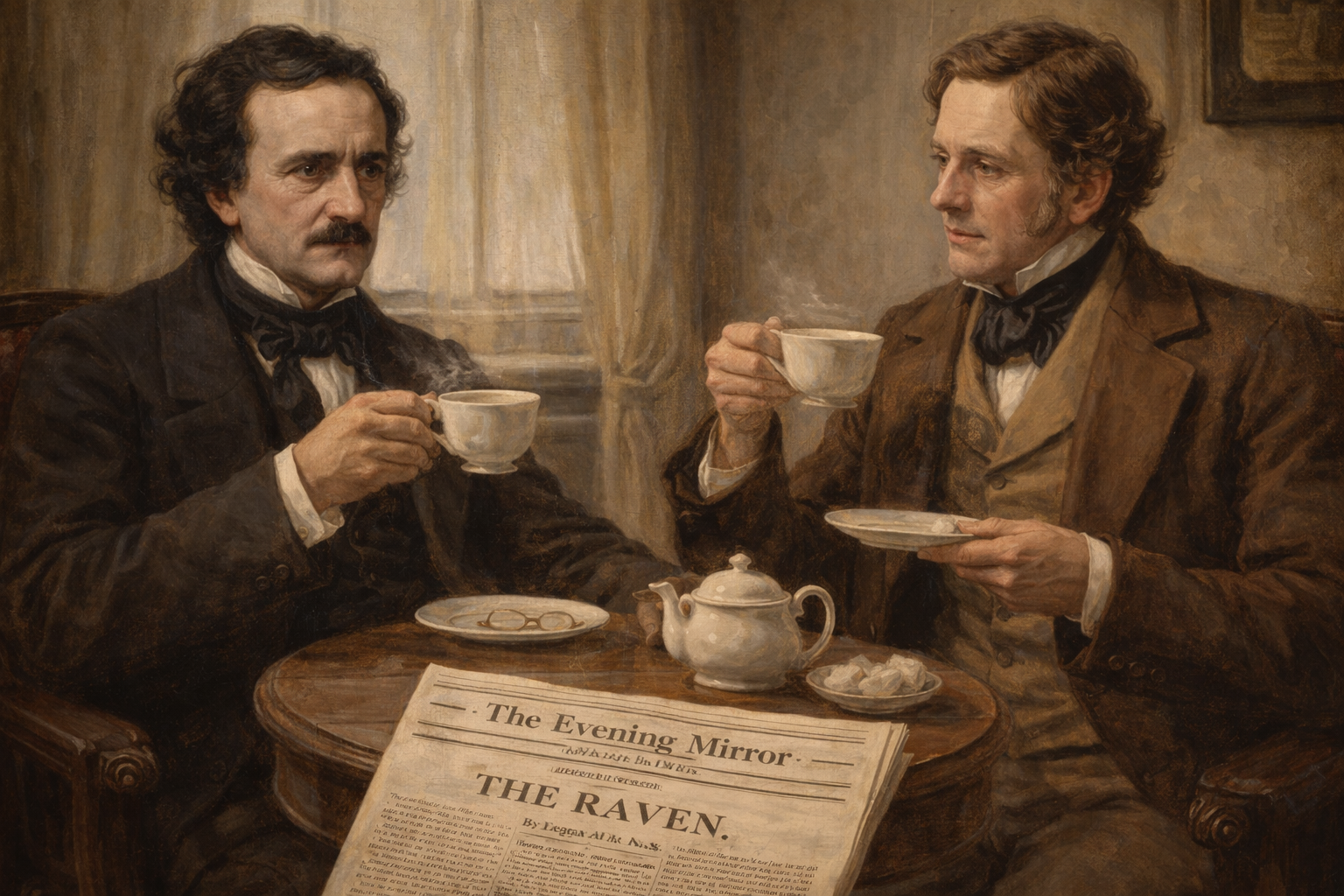
In the history of American literature, Edgar Allan Poe is often portrayed as a solitary figure—brilliant, embattled, and perpetually at odds with the institutions of his time. Yet Poe did not operate in isolation. Like all professional writers of the nineteenth century, his career was shaped by editors, newspapers, and publishing networks that determined what reached the public and how it was framed. Among the most consequential of these figures was Nathaniel Parker Willis, an editor whose decisions played a decisive role in the public emergence of Poe’s most famous poem, “The Raven.”
The relationship between Poe and Willis is not speculative. It is documented. It survives in manuscript correspondence, in newspaper publication records, and in editorial articles written by Willis himself. When examined together, these primary sources reveal a professional relationship grounded in editorial authority, mutual familiarity, and a shared participation in the mid-nineteenth-century literary press.
The New York Literary World of the 1840s
By the early 1840s, New York had become one of the most important centers of American periodical publishing. Newspapers and literary weeklies reached audiences far beyond the city itself, shaping national literary taste through reprints, reviews, and editorial commentary. Editors were not passive conduits; they were cultural gatekeepers whose choices determined which writers gained visibility.
Nathaniel Parker Willis was one of the most prominent of these editors. Already well known as a writer, traveler, and literary figure, Willis occupied positions of editorial authority that gave him direct influence over what appeared in print. His papers, particularly the Evening Mirror, reached a wide readership and were closely followed within literary circles.
Edgar Allan Poe, meanwhile, was an ambitious and often financially precarious writer navigating this same ecosystem. He wrote criticism, fiction, poetry, and editorial material for a range of publications, frequently relying on editors to secure placements that would keep him solvent and visible.
A Documented Professional Relationship
The professional connection between Poe and Willis is firmly established by surviving manuscript evidence. A handwritten letter dated October 13, 1842, written by Willis and addressed to Poe, survives as a primary document. In this letter, Willis discusses editorial engagements, periodical writing, and publication logistics. The tone is professional and collegial, reflecting an ongoing working relationship rather than a distant acquaintance.
This letter demonstrates several key facts beyond dispute. First, Poe and Willis were in direct correspondence several years before the publication of “The Raven.” Second, Willis was actively involved in editorial decision-making and capable of facilitating or restricting publication opportunities. Third, Poe regarded Willis as someone worth approaching for professional assistance.
This manuscript letter is not retrospective; it captures the mechanics of literary labor as they were unfolding in real time. It establishes that Willis was not merely a later commentator on Poe’s work, but a participant in the editorial world Poe inhabited.
The Raven and the Evening Mirror
The most consequential intersection of Poe’s writing and Willis’s editorial authority occurred in January 1845, when “The Raven” appeared in the Evening Mirror. The poem was printed prominently and credited to Poe, accompanied by editorial praise that framed it as a work of exceptional originality.
This publication was not incidental. Newspapers of the period did not routinely print long poems, nor did they often elevate them as headline material. The decision to publish “The Raven” in this format reflects a deliberate editorial judgment. Under Willis’s authority, the Evening Mirror presented the poem not as a minor literary curiosity but as a major cultural event.
The impact was immediate. The poem was rapidly reprinted, discussed, and circulated, transforming Poe’s reputation almost overnight. While Poe would receive little direct financial reward, the publication established “The Raven” as a defining work of American poetry.
Editorial Framing and Public Reception
Equally important as the act of publication was the editorial framing that accompanied it. Willis’s paper did not merely print the poem; it endorsed it. The language surrounding “The Raven” positioned Poe as a writer of singular imaginative power, encouraging readers to engage with the poem seriously rather than dismissing it as eccentric or obscure.
This framing mattered. In the nineteenth-century press, editorial commentary often guided interpretation as much as the text itself. By attaching his paper’s authority to Poe’s poem, Willis shaped how “The Raven” was received and discussed in subsequent reprints.
This was not an isolated act of generosity. It reflected Willis’s understanding of the press as a cultural instrument and his willingness to use it to elevate work he believed merited attention.
After Poe’s Death: Editorial Testimony
Poe died in October 1849 under circumstances that quickly became the subject of rumor and moral judgment. In the years following his death, competing narratives emerged—some hostile, others sympathetic. Among the most significant contemporary responses were those written by Willis.
In an article originally published in The Home Journal and later reprinted in regional newspapers, Willis offered a public editorial account of Poe based on personal knowledge. Although often referred to as a “letter,” this piece was a published article intended for public readership.
In this article, Willis described Poe’s habits as a working writer, his reliability in editorial contexts, and his personal character as Willis had observed it. The tone is corrective rather than sentimental, addressing misconceptions while grounding claims in firsthand experience.
The importance of this article lies not in literary criticism, but in testimony. Willis wrote as someone who had employed Poe, corresponded with him, and shared editorial spaces with him. His account stands apart from later biographical constructions precisely because it does not rely on hearsay.
Reprinting and Circulation
The continued circulation of Willis’s article—evidenced by its reprinting in newspapers such as the Democrat and Sentinel in 1858—demonstrates the lasting authority attributed to his perspective. Editors and readers alike regarded Willis as a credible witness to Poe’s professional life.
This reprinting also reflects the mechanics of nineteenth-century print culture, in which authoritative articles were frequently disseminated far beyond their original publication. In this way, Willis’s editorial voice continued to shape Poe’s posthumous reputation long after both men had exited the immediate literary scene.
Editorial Power and Literary Survival
When viewed together, the surviving documents—manuscript correspondence, newspaper publication records, and editorial articles—reveal a consistent pattern. Willis exercised editorial authority in ways that materially affected Poe’s visibility, reputation, and legacy.
This does not reduce Poe’s achievement to editorial patronage. “The Raven” succeeded because it resonated with readers. But resonance alone does not explain why the poem reached so many readers so quickly. That outcome required an editor willing to take the risk of prominent publication and endorsement.
Willis was such an editor.
The Value of Primary Documents
The relationship between Poe and Willis has often been simplified in secondary accounts, reduced either to anecdote or to moral narrative. The surviving primary documents tell a more grounded story—one of professional interaction within a dynamic print economy.
By examining the manuscript letter, the Evening Mirror publication, and Willis’s later editorial article together, we see not a mythologized friendship, but a documented editorial relationship. This distinction matters. It allows Poe’s work to be understood within the material conditions that made its circulation possible.
Conclusion
Edgar Allan Poe’s rise to enduring literary prominence cannot be separated from the nineteenth-century press that carried his work into public consciousness. Among the editors who shaped that press, Nathaniel Parker Willis occupies a central and documentable position.
Through editorial authority, public endorsement, and later testimonial writing, Willis played a measurable role in the history of “The Raven” and in the preservation of Poe’s reputation. This role is not inferred; it is recorded—in ink, in print, and in the surviving artifacts of American literary culture.
The documents presented alongside this article do not merely illustrate this relationship. They constitute it.
The editorial world Willis and Poe inhabited was already taking shape years before their New York collaboration. In December 1839, Poe’s debut fiction collection was being advertised in the Daily National Intelligencer — a Washington newspaper whose readership overlapped with the very literary establishment both men would navigate throughout the 1840s.