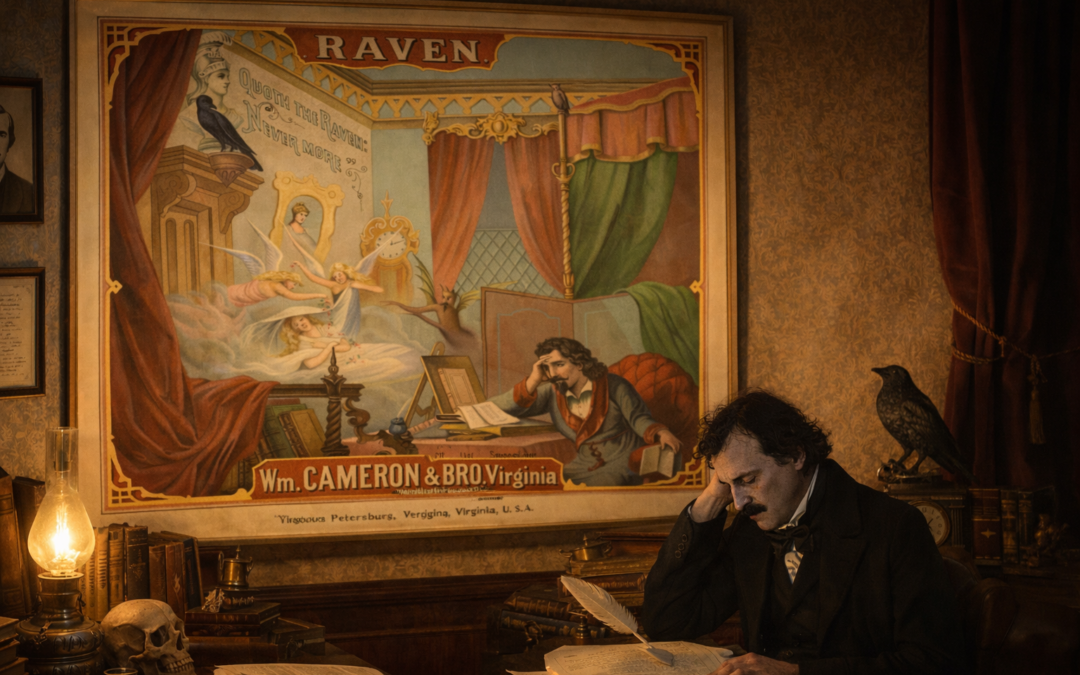
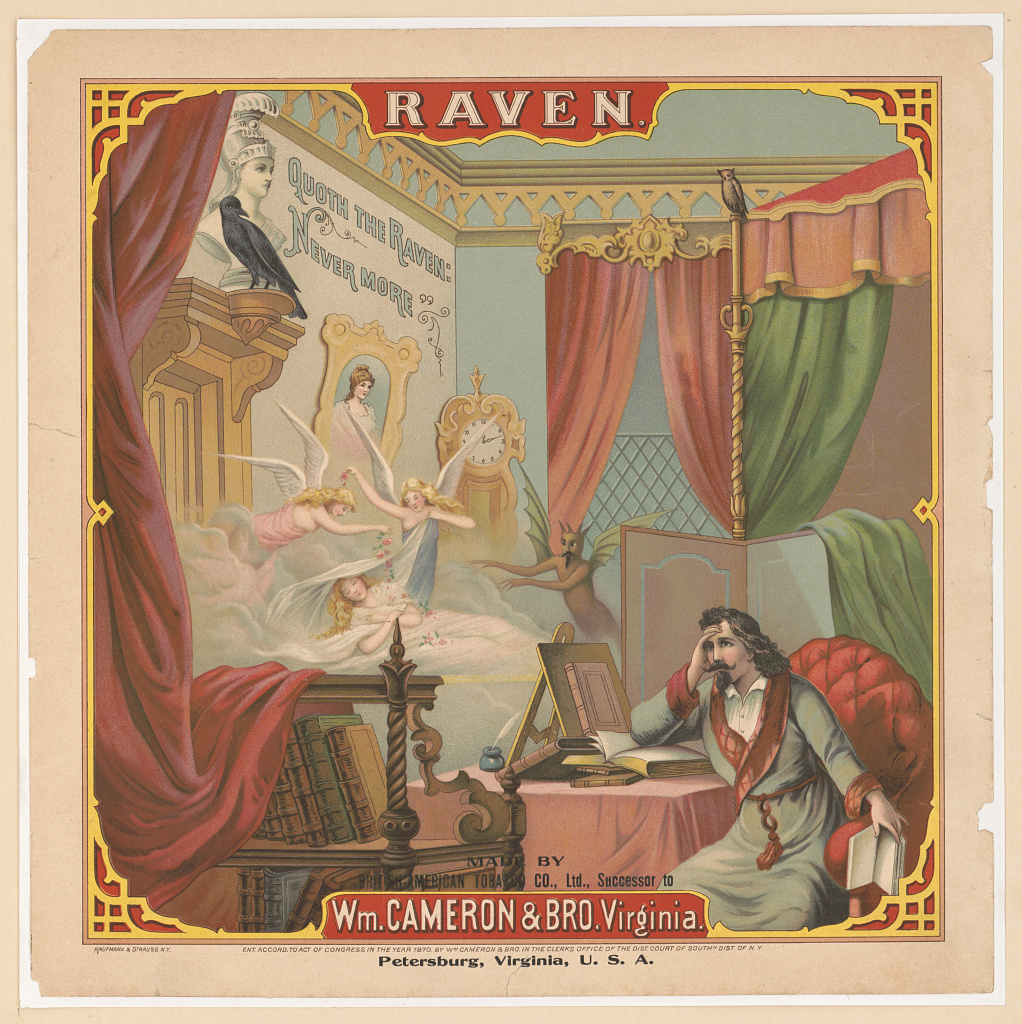
This 19th-century chromolithograph is one of the clearest signs that Edgar Allan Poe had already crossed from literature into lived culture. It isn’t an illustration made to accompany a book or a poem—it’s an advertisement. And yet it leans completely on the psychological weight and symbolism of The Raven, trusting that the viewer will immediately understand what that raven means.
The scene is domestic but uneasy. A man sits awake at a table littered with books, his posture rigid, his expression strained. Sleep is nowhere near him. His thoughts appear trapped in a loop—intellectual, obsessive, unresolved. Behind him, separated almost emotionally rather than physically, a woman sleeps peacefully. Small, angelic figures hover near her, suggesting protection, innocence, or undisturbed rest. The division between the two figures is striking: one mind tormented by wakefulness, the other untouched by it.
Above them, perched near a classical bust often interpreted as Minerva—the goddess of wisdom and reason—sits the raven. On the wall behind it are the words that collapse any ambiguity:
“Quoth the Raven: Nevermore.”
With that line, the image stops being merely decorative. It becomes psychological. In Poe’s poem, the raven is not just a bird; it is the embodiment of memory, grief, and the cruel permanence of loss. Here, the raven presides over a sleepless scholar, turning his study into a mental prison. Knowledge, books, and contemplation have not brought peace—only repetition.
Selling a State of Mind
What makes this image remarkable is its purpose. Created as a commercial print—likely tied to tobacco marketing—it uses literature not as ornament, but as emotional shorthand. By the 1870s, Poe’s raven was already universally recognizable. No explanation was needed. One line, one bird, and an entire emotional landscape snapped into place.
This is advertising that doesn’t promise happiness or excitement. Instead, it aligns itself with introspection, intellect, late nights, and troubled thoughts. The product is positioned not as an escape from unease, but as something that belongs within it. The implication is subtle: this is for readers, thinkers, insomniacs—for those whose minds refuse to go quiet.
Poe Beyond the Page
Images like this reveal something essential about Poe’s legacy. He wasn’t simply read—he was absorbed. His work became visual language. The raven, the refrain, the mood of unending thought seeped into homes, businesses, and popular art. Poe had already become symbolic infrastructure.
This print sits at a crossroads where literature, psychology, and commerce intersect. It shows The Raven functioning exactly as it does in the poem: not telling a story, but haunting a space. The bird doesn’t attack. It doesn’t move. It simply watches—and that is enough.
A Quiet, Lingering Presence
What lingers most in this image is not the product it once promoted, but the atmosphere it creates. A single awake mind. A silent room. A phrase that refuses to change. The raven does not need to speak again. “Nevermore” has already done its work.
This is Poe not as author, but as presence—perched, patient, and inescapable.
High-Resolution TIFF:
A full-resolution TIFF version of this image is available here for detailed viewing and research