The complete original newspaper publication, its historical moment, and how a single printed page unleashed “Nevermore” upon the world
The Newspaper Page That Changed American Literature
Before The Raven became one of the most recognizable poems in the English language, before it was memorized by schoolchildren, quoted in films, parodied endlessly, and absorbed into the architecture of gothic culture, it existed in a far more fragile form.
It existed as a single newspaper page.
On January 29, 1845, readers of the New York Evening Mirror encountered a poem unlike anything previously printed in an American newspaper. Long. Rhythmically insistent. Dark. Hypnotic. Introduced not as filler, but as an event.
That page—the original newspaper publication of “The Raven”—is reproduced here in full.
Not excerpted.
Not modernized.
Not separated from its historical context.
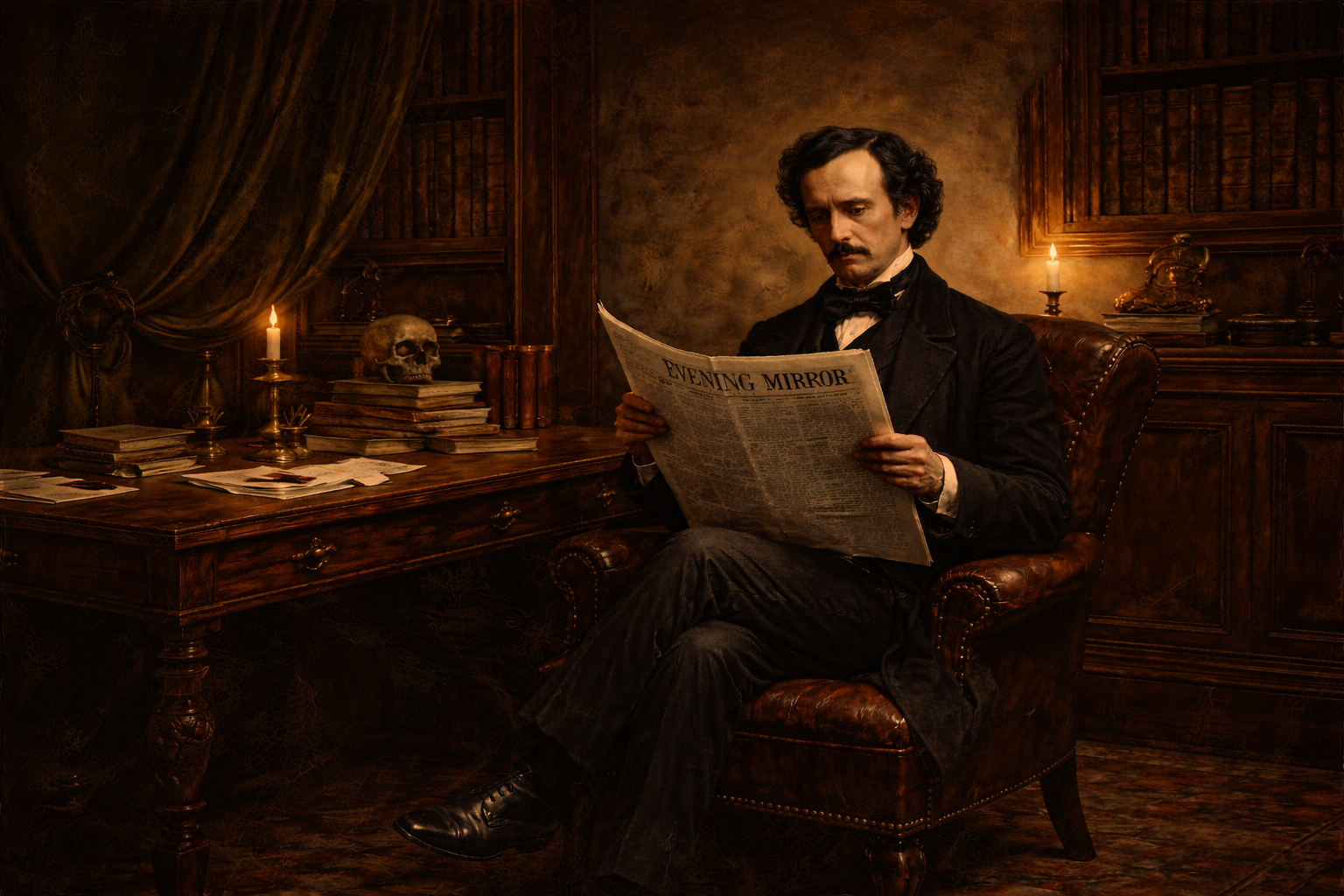
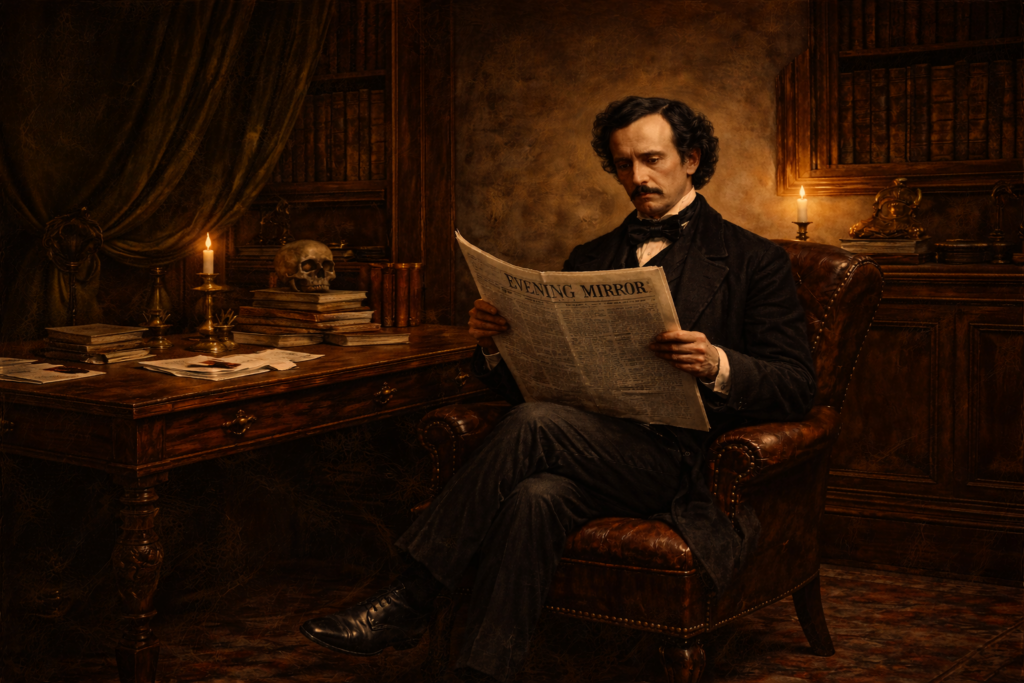
This is the precise form in which nineteenth-century readers first met the poem. It is the moment The Raven entered public consciousness—not as a book, not as a collected work, but as living, circulating media.
To understand The Raven, one must understand this page.
Why the First Publication Matters More Than Any Later Edition
Most discussions of The Raven focus on symbolism, meter, or biography. Far fewer focus on the medium that made the poem famous.
In 1845, newspapers were the fastest-moving cultural force in America. They were shared aloud, passed between households, clipped, recopied, memorized, and debated. They reached audiences far beyond those who purchased poetry books or literary magazines.
Publishing The Raven in a newspaper did not simply announce the poem—it activated it.
The Evening Mirror framed the poem with an editorial introduction that was unusually confident, even prophetic. The editor praised the poem’s “subtle conception,” “masterly ingenuity of versification,” and predicted that it would “stick to the memory of everybody who reads it”—a claim that history has proven almost eerily accurate.
This framing mattered. Readers were primed to listen, to remember, to repeat.
The poem did not quietly debut.
It arrived already echoing.
How “The Raven” Reached the Newspaper Before the Magazine
Originally, The Raven was scheduled to appear in the February 1845 issue of The American Review, a literary magazine that often published works anonymously or under pseudonyms. Poe had agreed to this arrangement, following the conventions of the time.
But fate—and friendship—intervened.
Poe’s acquaintance Nathaniel Parker Willis, a leading editor and prominent literary figure of the period, obtained an advance copy of the poem from The American Review. Recognizing at once that this was not a work that could wait for scheduled circulation, Willis acted decisively.
He published the poem early, under Poe’s real name, in the New York Evening Mirror.
That single editorial decision changed American literary history.
By appearing first in a newspaper rather than a quarterly review, The Raven reached:
- A vastly larger audience
- Readers who encountered it aloud
- A public accustomed to sharing and reprinting content rapidly
The poem spread with extraordinary speed.
The Page as Artifact: Reading “The Raven” in Its Original Context
Seeing The Raven as it appeared in the Evening Mirror reveals details modern editions erase.
The typography is dense.
The lines run long.
The poem occupies a large physical space on the page.
Around it swirl advertisements, announcements, and the ordinary noise of nineteenth-century urban life. This juxtaposition matters. It shows The Raven not as a sacred literary object, but as something disruptive—an intrusion of psychological darkness into everyday print culture.
Readers encountered the poem while skimming news, scanning notices, and flipping pages. And then they stopped.
The poem demanded attention.
Its rhythm did not allow passive reading. Its repetition made memorization almost unavoidable. Its refrain—Nevermore—latched onto the mind with mechanical precision.
This was not accidental.
A Poem Engineered for Memory
Later in life, Edgar Allan Poe admitted openly that The Raven was carefully constructed. He did not claim divine inspiration or spontaneous genius. He described the poem as designed.
Designed for:
- Oral recitation
- Emotional impact
- Memorability
- Repetition
The poem’s trochaic octameter creates a pounding, almost obsessive rhythm. Its internal rhymes stack sound upon sound. Its structure mirrors the mental loop of grief itself—questions asked despite knowing the answer will hurt.
The newspaper format amplified these qualities.
Newspapers were read aloud in homes and public spaces. Poems printed there became performances. The Raven was not merely read—it was heard.
Why “The Raven” Worked Where Others Did Not
America had no shortage of poetry in the 1840s. What it lacked was poetry that embraced psychological horror without moral reassurance.
The Raven offers no comfort.
No redemption.
No lesson.
The narrator does not grow wiser.
He does not heal.
He does not escape.
The raven does nothing supernatural in any explicit sense. It simply answers. And that answer becomes unbearable.
This restraint is precisely why the poem endured.
Readers were not told what to think. They were trapped inside a mind unraveling in real time.
The Speed of Cultural Contagion
Once published in the Evening Mirror, The Raven spread rapidly.
Newspapers across the United States and Great Britain reprinted it. Readers copied it by hand. Parodies appeared almost immediately—The Owl, The Veto, The Turkey, and more.
Parody, in this case, was proof of dominance. One cannot parody what has not already embedded itself deeply into culture.
Even Poe seemed astonished by the speed of the poem’s success. He became known publicly as “The Raven,” a nickname he reportedly disliked but could not escape.
The poem did exactly what the newspaper introduction predicted: it stuck.
For Whom Was “The Raven” Written?
Despite its technical sophistication, The Raven was not written exclusively for elite literary circles.
It spoke to:
- Readers familiar with death and mourning
- A society accustomed to loss from disease and poverty
- An audience suspended between rationalism and superstition
- Anyone who had replayed grief internally, long after others expected healing
The poem’s setting—a single room, a single night—made it intimate. Its voice felt personal, confessional, uncomfortably familiar.
The newspaper medium ensured that this intimacy reached beyond salons and lecture halls into ordinary life.
Fame Without Fortune
Ironically, The Raven brought Poe fame but not financial security.
He was paid little for the poem’s publication. Its widespread reprinting earned him prestige, lecture invitations, and social access—but not wealth. The poem belonged to the public almost immediately.
This too is part of the newspaper’s legacy.
Newspapers created mass culture, but they did not protect authors. The Raven became immortal, while its creator remained precarious.
Why This Original Newspaper Page Matters Today
Today, The Raven exists everywhere—in textbooks, anthologies, digital archives, and pop culture references. But the original newspaper page remains rare, fragmented, often excerpted rather than presented whole.
That absence matters.
Seeing the poem as it first appeared reveals:
- How it was framed editorially
- How readers physically encountered it
- How literature competed with commerce for attention
- How poetry once traveled at the speed of news
This page is not merely an early version of the poem.
It is the moment of ignition.
A Gothic Artifact, Not Just a Text
For gothic culture, The Raven is not simply influential—it is foundational. It marks a shift from external horror (castles, specters, ruins) to internal horror: memory, obsession, grief.
The newspaper page captures this shift mid-flight.
It shows the exact moment when American literature learned that terror did not require monsters—only a voice, a rhythm, and a truth that refuses consolation.
Why This Page Exists
This publication exists to preserve the artifact, not just the poem.
To present The Raven:
- As it first appeared
- In the medium that made it famous
- With the context that explains its explosive reach
This is not a summary.
Not a quotation.
Not a reinterpretation.
It is the historical page itself—and the story of how that page changed literature forever.
Still Sitting. Still Watching. Still Answering.
The raven has never left the bust of Pallas.
The lamp still throws its shadow.
The word still answers.
The page still speaks.
And from that single newspaper printing in January 1845, the echo continues.
Nevermore.