
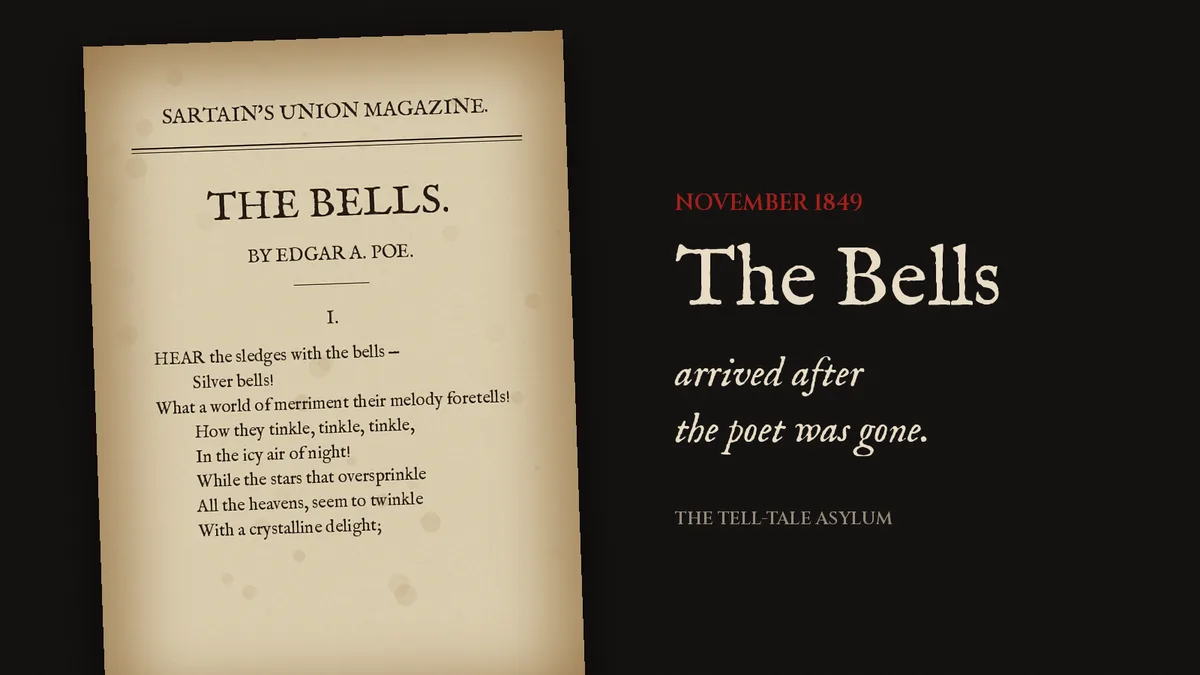
The November 1849 number of Sartain’s Union Magazine reached readers around October 15, little more than a week after Edgar Allan Poe died in Baltimore. On page 304, under the heading “THE BELLS. BY EDGAR A. POE.,” it opened with a winter scene:
HEAR the sledges with the bells — Silver bells! What a world of merriment their melody foretells!
The readers who met those lines first were reading a dead man’s newest work. It was not the last poem he wrote, but for a few weeks in autumn of 1849 the papers treated it that way.
A joke at Mrs. Shew’s
The poem began as a game. Marie Louise Shew, who had nursed Poe’s wife Virginia through her final illness, later recalled a visit from Poe in 1848. He told her he had to write a poem and had no subject, and that the bells of a nearby church were getting on his nerves. She wrote out a few lines in mock imitation of his style. He took the page and finished it, and the early manuscript carries the heading “By Mrs. M. L. Shew.” Thomas Ollive Mabbott, Poe’s great editor, dated that draft to about May 1848.
It was a short thing: seventeen lines in the Shew draft, eighteen in the copy Poe revised and sold to the Union Magazine for fifteen dollars.
The poem grows
Poe didn’t leave it there. A letter to Annie Richmond of February 8, 1849 lets Mabbott date the long version to two days earlier. In the last week of May 1849, visiting Mrs. Richmond in Lowell, Massachusetts, Poe recited the new poem to a reading club in nearby Westford.
The magazine, renamed Sartain’s Union Magazine, paid twenty-five dollars for the expanded text and five more after a final revision. Over three sales, “The Bells” earned Poe forty-five dollars.
The finished poem moves through four kinds of bells across four sections: silver sleigh bells, golden wedding bells, brazen alarm bells and iron funeral bells. Each stanza is longer and heavier than the last, and the word “bells” is repeated until it stops being a word and becomes a sound.
“Poe’s Last Poem”
The newspapers moved quickly. Horace Greeley’s New-York Daily Tribune reprinted the poem on its front page on October 17, 1849, under the heading “Poe’s Last Poem.” On October 20 it appeared in the Daily Mercury of New Bedford and in Neale’s Saturday Gazette in Philadelphia, both credited to Sartain’s.
On October 27, Nathaniel Parker Willis reprinted it in the Home Journal with the same heading. He introduced it as a “remarkable poem by the late Edgar A. Poe.” Willis, who had already defended Poe in print against Rufus Griswold’s obituary, gave the poem the kind of introduction Poe had always valued from him.
The same poem, a month later
The December 1849 Sartain’s did something unusual. It printed “The Bells” again, this time in its early eighteen-line form, with an account of the poem’s history by the magazine’s editor, John S. Hart. Readers who had just met the finished poem could now see the sketch it grew from.
Hart’s note also pointed toward another poem in the magazine’s keeping. “Annabel Lee” had been sent to Sartain’s as well and was in type before Poe died. It appeared there in January 1850, though by then it had already run in the Tribune and the Southern Literary Messenger. We followed that poem’s own first printings here.
So the title of “last poem” passed from one to the other within a few months, and neither was quite the last thing Poe wrote. What “The Bells” can claim is that it was the first new Poe poem the public met after his death, and that it arrived ringing.
Sources
- “The Bells,” Sartain’s Union Magazine, Vol. V, no. 5 (November 1849), p. 304.
- “The Bells” (early version) with John S. Hart’s editorial note, Sartain’s Union Magazine, December 1849, pp. 386–387.
- “Poe’s Last Poem,” New-York Daily Tribune, October 17, 1849, p. 1.
- N. P. Willis, “Poe’s Last Poem,” Home Journal, October 27, 1849.
- John S. Hart, letter on “The Bells” and “Annabel Lee,” New-York Daily Tribune, November 17, 1875.
- Thomas Ollive Mabbott, ed., Collected Works of Edgar Allan Poe, Vol. I: Poems (1969), notes to “The Bells.”
Further Poe primary sources: the Edgar Allan Poe collection at Crypt of Echoes.
From the Crypt: Bells of a darker kind hang on the back cover of The Legend of Krampus, our spoken-word Krampus telling on vinyl.