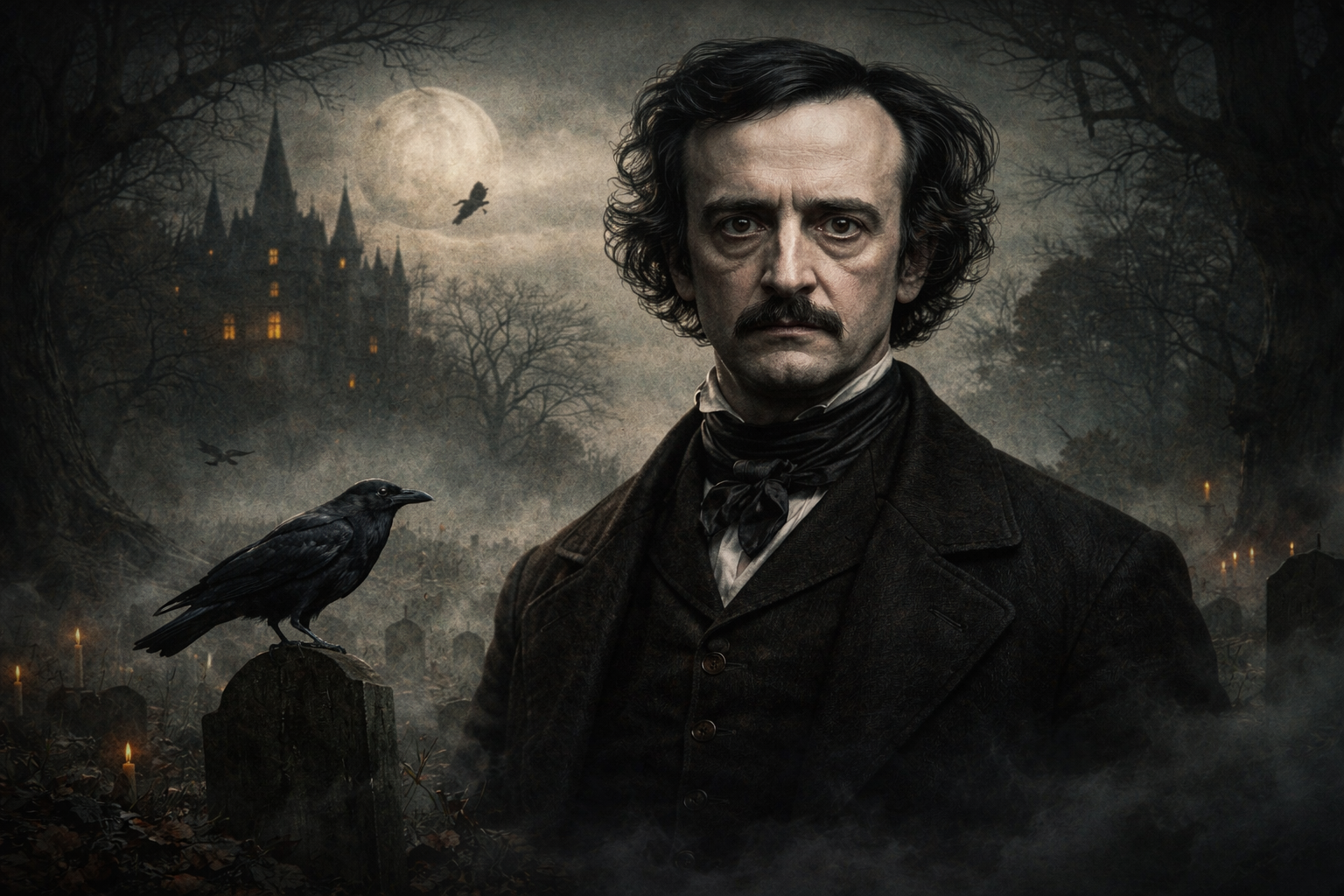
Few figures in American literature stand as tall—or cast as long a shadow—as Edgar Allan Poe. His name evokes images of candlelit chambers, storm-tossed nights, and the ever-present whisper of madness that lurks just beneath the surface of the civilized mind. Poe was not merely a writer of macabre tales; he was an architect of psychological terror, a master of rhythm and sound, and a pioneer whose influence seeps through every crack of modern horror and mystery writing. Nearly two centuries after his death, readers and scholars alike remain enthralled by his genius and haunted by his mysteries.
Who Was Edgar Allan Poe? (Early Life & Background)
Born on January 19, 1809, in Boston, Massachusetts, Edgar Allan Poe’s life began under a cloud of instability and loss. His parents—both actors by trade—died when he was very young, leaving him an orphan before the age of three. Taken in by John and Frances Allan of Richmond, Virginia, Poe never truly fit within their mercantile household. Though John Allan provided for him, there was an emotional distance and frequent conflict over finances and Poe’s ambitions as a writer rather than a businessman.
Poe attended the University of Virginia in 1826, excelling academically but falling into debt due to gambling, a habit born partly from his lack of familial support. His attempts at higher education and later military service ultimately succumbed to his restless temperament and strained relationships. What remained constant, however, was his devotion to the written word—a calling that would define both his triumphs and his tragedies.
Edgar Allan Poe’s Literary Career and Writing Style
Poe’s writing career was marked by brilliance intertwined with poverty. In an era when authorship rarely provided financial stability, Poe struggled to support himself through his pen. He worked as an editor, critic, and journalist, known for his sharp intellect and scathing literary reviews. Despite consistent hardship, his creative vision never wavered.
Edgar Allan Poe’s Most Famous Poems
The Raven (1845) is Poe’s most famous poem, first published in the New York Evening Mirror. A later illustrated edition published in 1884 by Harper & Brothers, featuring artwork by Gustave Doré, reflects the poem’s lasting cultural influence.
The Tell-Tale Heart (1843)
The Fall of the House of Usher (1839)
The Murders in the Rue Morgue (1841)
Annabel Lee (1849)
The Black Cat (1843)
Poe’s poetic works are often the first door through which readers encounter his haunting world. The Raven, published in 1845, is perhaps his most recognizable poem—an incantation of grief and madness that captures his mastery of meter and melancholy. Its hypnotic rhythm and refrain echo the despair of a mind unraveling under the weight of loss.
Annabel Lee, written near the end of his life, serves as both a love song and an elegy, steeped in the recurrent theme of a beloved lost to the cold grasp of death. Other notable works such as *“The Bells”* and *“A Dream Within a Dream”* deepen his exploration of mortality, time, and illusion, revealing a man who regarded poetry as both art and confession.
Edgar Allan Poe’s Most Influential Short Stories
As a craftsman of short fiction, Poe redefined the genre. His tales of mystery and horror remain foundational texts for modern readers and writers alike.
The Tell-Tale Heart is a chilling portrayal of guilt personified—the steady beat of a dead man’s heart as the sound of a murderer’s unraveling mind. The Fall of the House of Usher conjures claustrophobic dread through its decaying mansion, familial doom, and eerie atmosphere. And with The Murders in the Rue Morgue, Poe invented the detective story, crafting a logical, analytical protagonist in C. Auguste Dupin—precursor to the likes of Sherlock Holmes and Hercule Poirot.
Why is Edgar Allan Poe So Important to Literature?
Poe’s genius lies not only in his stories and poems but in how he reshaped the literary landscape. He blended Gothic horror with psychological realism, exploring the darkness of human thought long before psychology existed as a formal science. He was one of the first writers to make the inner workings of the mind—obsession, paranoia, guilt, grief—the true subject of horror.
He is also credited with laying the foundations of detective fiction, a genre he forged almost single-handedly. Poe’s methodical structuring of clues, logic, and suspense revolutionized narrative form and inspired whole generations of writers, from Arthur Conan Doyle to Agatha Christie. His fascination with the limits of reason and the allure of madness set the stage for countless literary descendants.
How Did Edgar Allan Poe Die?
If his works dwell in shadow, his death remains the darkest chapter of all. On October 3, 1849, Poe was discovered delirious on the streets of Baltimore, incoherent and wearing someone else’s clothes. He was taken to Washington College Hospital, where he drifted in and out of consciousness before dying four days later. He was just forty years old. The cause of death was officially listed as “congestion of the brain,” but the true circumstances remain a matter of endless speculation.
Theories About Edgar Allan Poe’s Death
Over the decades, multiple theories have arisen to explain Poe’s mysterious demise.
One of the most common suggests alcohol poisoning, citing his known difficulty with drink. Others propose that illness perhaps rabies, meningitis, or diabetes could have led to his physical and mental breakdown. A particularly intriguing theory involves cooping, a 19th-century form of voter fraud in which victims were kidnapped, forced to consume intoxicants, disguised, and made to vote multiple times. The state in which Poe was found—disheveled, confused, and wearing ill-fitting clothes seems to echo the signature of this cruel practice.
Still others believe his death may have resulted from personal enmities, untreated illness, or sheer exhaustion after years of instability. No one knows for certain, and perhaps it is fitting that the father of Gothic mystery should exit this world wrapped in one final enigma.
Edgar Allan Poe’s Legacy and Influence Today
Poe’s shadow endures in literature, film, music, and modern culture. His psychological complexity continues to inspire writers of horror and crime fiction, while his aesthetic of melancholy and decay permeates gothic art and popular media. From H. P. Lovecraft to Stephen King, from the lyrics of rock musicians to the brooding heroes of cinema, the ghost of Poe remains.
His influence extends beyond his written works—into the very idea of the tortured artist, the vision of genius intertwined with tragedy. Universities dissect his mechanics of suspense; readers feel his rhythmic grip across centuries. In an age fascinated by both crime and confession, Poe feels more relevant than ever. His stories remind us that the human heart, though fragile and dark, beats with an immortal rhythm.
Why People Still Read Poe Today
Readers return to Poe not simply for fright, but for truth—truth about fear, obsession, and the frailty of reason. His characters confront the abyss, and in that confrontation, they mirror us. He remains timeless because his terror is psychological, not merely supernatural; the shadows he casts fall within the mind itself.
Conclusion
Edgar Allan Poe lived a life as turbulent and enigmatic as his stories, but his artistic triumphs transcended his mortal struggles. He distilled beauty from despair, order from chaos, meaning from madness. His works continue to whisper through the corridors of literature, shaping everything from thrillers to Gothic romances. More than any other American writer, Poe proved that the human soul’s darkest recesses are not to be feared but understood—and in understanding, we find both horror and art.
More than a century and a half after his final breath, Edgar Allan Poe still writes through us all.
From the Archive
The Raven was not only read — it was performed. An early spoken-word recording preserves Poe’s poem as sound, capturing its rhythm, restraint, and psychological weight at a moment when literature was first being translated into recorded form.
Listen to one of the earliest audio interpretations of The Raven and explore how Poe’s words were meant to be heard.