Edgar Allan Poe’s The Raven on Vinyl: A Spoken-Word Artifact for the Modern Gothic Reader
Edgar Allan Poe’s The Raven is one of those rare literary works that almost everyone recognizes, yet few truly experience anymore. Quoted endlessly, parodied relentlessly, and visually referenced to the point of abstraction, the poem has become a cultural symbol more than a text. In the process, its original force—its rhythm, its claustrophobia, its slow psychological collapse—has often been dulled.
The 7-inch spoken-word vinyl edition of The Raven released by The Raven’s Crypt offers a corrective to that flattening. Rather than attempting to modernize the poem or overwhelm it with theatrics, this release treats The Raven as what it has always been: a tightly engineered literary work designed to be heard as much as read. The result is not a novelty record, but a focused literary artifact that invites sustained attention.
This review examines the release in depth, from the poem itself to the performance, the vinyl format, and the broader context of The Raven’s Crypt as an emerging gothic publisher committed to physical media and literary preservation.
The Raven as a Primary Text, Not a Theme
At the heart of this release is the complete, unabridged text of The Raven. That decision alone separates it from many modern adaptations, which often shorten the poem, rearrange lines, or bury the verse beneath sound design. Here, Poe’s poem is presented intact, respecting its original structure and pacing.
This matters because The Raven is built on accumulation. Each stanza tightens the psychological vise, and each repetition of “Nevermore” gains power only because nothing is removed. The poem’s effect depends on endurance—both the speaker’s and the listener’s. Any abridgment breaks that spell.
By preserving the full text, this release positions itself as a primary literary presentation rather than an interpretation. It does not explain the poem, dramatize it excessively, or attempt to soften its intensity. It simply delivers the work as written and allows the listener to experience it on its own terms.
Spoken Word That Respects the Meter
The spoken-word performance on this vinyl avoids one of the most common pitfalls of Poe adaptations: overacting. Rather than leaning into exaggerated menace or gothic melodrama, the narration allows Poe’s meter and internal rhyme to do the work.
The trochaic rhythm of The Raven is notoriously difficult to handle. Read too flat, it becomes sing-song. Read too theatrically, it collapses into caricature. The performance here threads that needle carefully. The delivery is steady, controlled, and attentive to the poem’s sonic architecture.
This restraint enhances the poem’s psychological weight. The listener is not distracted by vocal performance but drawn into the repetition, the tightening logic, and the inescapable refrain. Each return of “Nevermore” feels less like a dramatic cue and more like a sentence being passed.
Why Vinyl Is the Right Medium
Releasing The Raven on vinyl is not a gimmick; it is a deliberate alignment of form and content. Vinyl demands attention in a way that digital formats do not. It asks the listener to commit to a linear experience, to sit with the sound rather than skim it.
This is especially important for spoken word. The Raven is not background listening. Its effect depends on focus, repetition, and time. Vinyl enforces that pacing. There is no skipping ahead, no casual multitasking. You listen from beginning to end, just as the poem intends.
The 7-inch format is particularly well suited to the poem’s length. At roughly eight and a half minutes, The Raven fits comfortably without compression or filler. There is no attempt to pad the record with additional material. The object exists solely to deliver the poem, and that clarity of purpose strengthens the experience.
Audio Quality and Presence
Pressed at 45 RPM, the audio presentation benefits from clarity and immediacy. The voice feels present and close, reinforcing the intimacy of the poem’s setting. Surface noise, when present, does not detract from the experience; instead, it subtly reinforces the physicality of the medium.
This sense of presence mirrors the poem’s emotional core. The Raven is a solitary work—a single speaker in a confined space, confronted by an unyielding answer. Hearing it through a medium that emphasizes physical proximity rather than digital distance enhances that effect.
Physical Design as Literary Extension
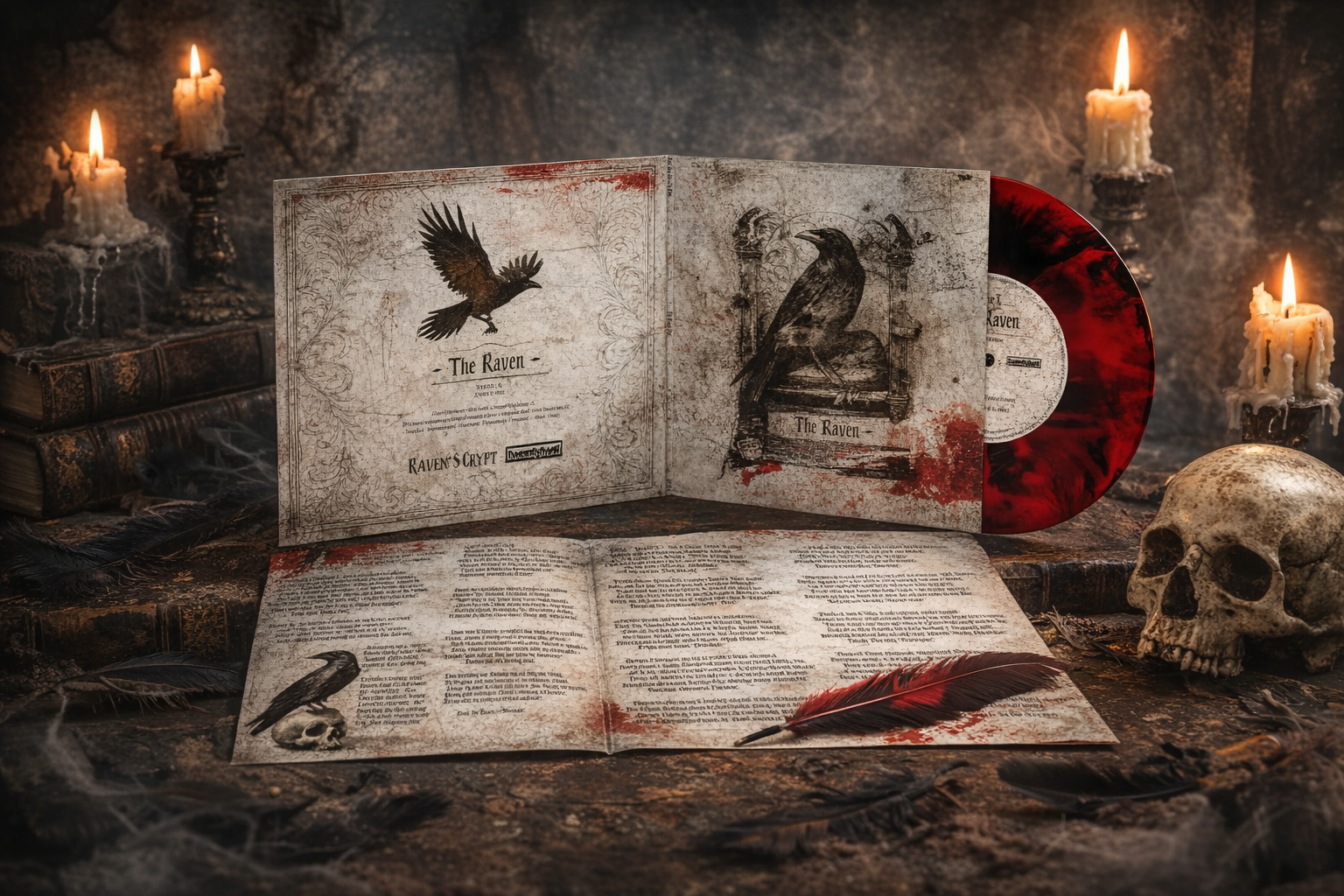
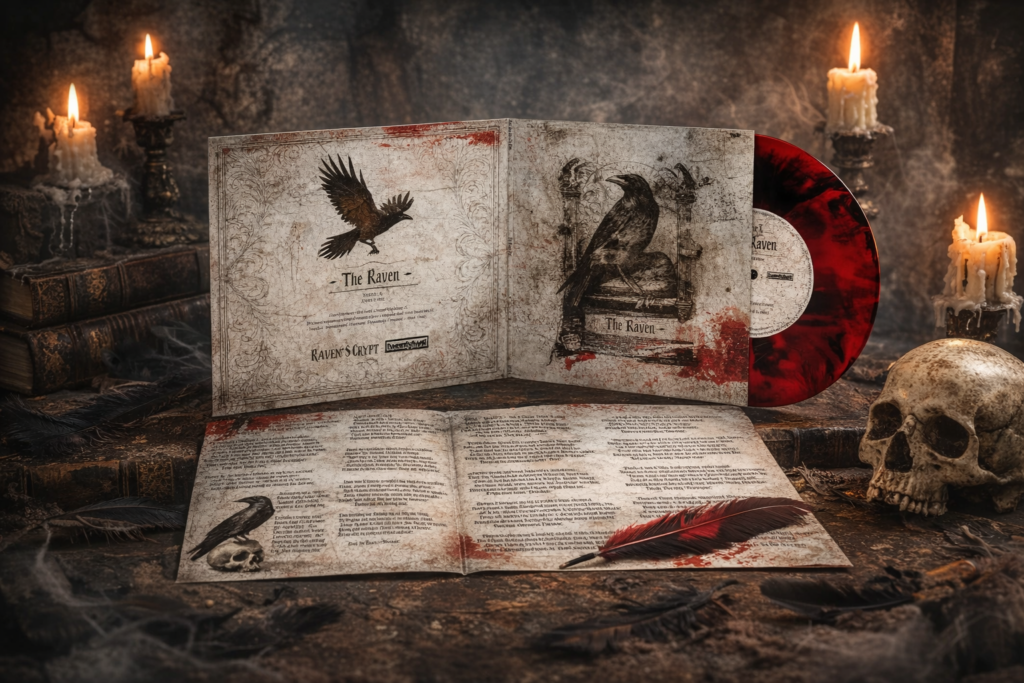
The physical presentation of this release reinforces its literary intent. The vinyl itself, rendered in a hand-poured red and black variant, visually echoes the poem’s emotional palette without resorting to literal illustration. Each pressing is slightly unique, reinforcing the idea that this is a crafted object rather than a mass-produced novelty.
The gatefold packaging extends that philosophy. Including the full text of the poem inside the jacket bridges the gap between record and book, allowing the listener to read along or revisit the poem independently of the audio. This integration of text and sound positions the record as a hybrid literary artifact rather than a simple audio product.
Nothing in the presentation feels extraneous. The design exists to serve the poem, not to overshadow it.
Experiencing The Raven Through Sound
Listening to The Raven rather than reading it reveals aspects of the poem that can be easy to overlook on the page. Poe’s emphasis on sound—internal rhyme, repetition, cadence—comes into sharper focus when voiced.
On vinyl, the refrain “Nevermore” takes on a ritualistic quality. Each repetition lands with increasing inevitability, not because of vocal emphasis but because the listener cannot escape it. The record enforces linear time, mirroring the speaker’s psychological confinement.
This enforced listening transforms the poem from a familiar text into an experience. Even readers who know The Raven well may find its structure and pacing newly oppressive when encountered this way.
Collectibility Without Empty Hype
This release does not rely on artificial hype or exaggerated claims of importance. Its collectibility comes from specificity rather than spectacle. It is an object made for a particular audience: readers, listeners, and collectors who value literary depth and physical media.
Rather than positioning itself as a centerpiece or defining statement, the record feels like part of a growing body of work. It assumes continuity rather than exception. That quiet confidence is part of what makes it compelling.
Where This Fits in The Raven’s Crypt Catalog
This 7-inch release is best understood as a considered entry within The Raven’s Crypt’s expanding catalog of spoken-word and gothic literature releases. It does not attempt to carry the brand or announce its arrival. Instead, it reinforces a consistent philosophy: classic texts deserve careful, physical presentation.
That approach suggests a long-term vision rather than a one-off experiment. The Raven’s Crypt appears less interested in chasing trends than in building an archive of objects that can stand alongside books, prints, and other forms of literary ephemera.
The Raven’s Crypt as an Emerging Gothic Publisher
The Raven’s Crypt occupies an unusual space in the modern gothic landscape. Rather than functioning purely as a merchandise brand or a novelty outlet, it operates more like a small independent publisher focused on physical media. Its releases emphasize permanence, intentionality, and respect for source material.
In an era dominated by digital abundance and disposable content, this commitment to physical artifacts feels almost contrarian. Yet it aligns closely with gothic literature’s historical roots, which have always been tied to objects: books, broadsides, engravings, and recordings meant to endure.
By approaching Poe’s work with seriousness rather than irony, The Raven’s Crypt positions itself as part of a broader revival of tactile, literature-centered gothic culture. It is not attempting to redefine Poe or modernize him beyond recognition. It is creating space for his work to be encountered again, slowly and deliberately.
Who This Release Is For
This vinyl edition of The Raven will appeal most strongly to listeners who already value the poem and want to experience it in a focused, intentional format. It suits collectors of gothic literature, spoken-word recordings, and physical media who appreciate objects that prioritize content over spectacle.
It is not designed for casual listening or seasonal novelty. That is a strength, not a limitation.
Final Assessment
The Raven on 7-inch vinyl from The Raven’s Crypt succeeds because it understands what the poem requires. It does not attempt to embellish, reinterpret, or dilute Poe’s work. Instead, it presents The Raven as a complete literary experience, delivered through a medium that reinforces its themes of repetition, confinement, and inevitability.
As a spoken-word record, it is restrained and effective. As a physical object, it is thoughtfully designed. As part of a broader catalog, it signals a commitment to treating classic gothic literature as something worth preserving in tangible form.
In a cultural environment saturated with references to The Raven but short on genuine engagement with it, this release offers something increasingly rare: the chance to listen, without distraction, as the poem unfolds exactly as Poe intended.
The tapping is still there. The answer is still final. And on vinyl, “Nevermore” lingers just a little longer.
Before The Raven found its way onto modern vinyl, it lived first as sound. An early spoken-word recording preserves Poe’s poem as it was meant to be heard — recited with deliberate pacing, restrained accompaniment, and an emphasis on rhythm over spectacle.
Explore the earliest recorded performance of The Raven and hear how Poe’s language sounded when captured at the dawn of recorded literature.