The Poem That Entered American Literature in Disguise**
In early 1845, American readers encountered a poem unlike anything they had seen before. It arrived quietly, embedded within the pages of a new literary and political journal, signed not by a known author but by a name that felt borrowed from another age. There was no fanfare, no illustration, no explanation beyond a brief editorial note. Yet within weeks, the poem had escaped its printed confines and spread across newspapers, parlors, lecture halls, and eventually across the Atlantic.
That poem was “The Raven.”
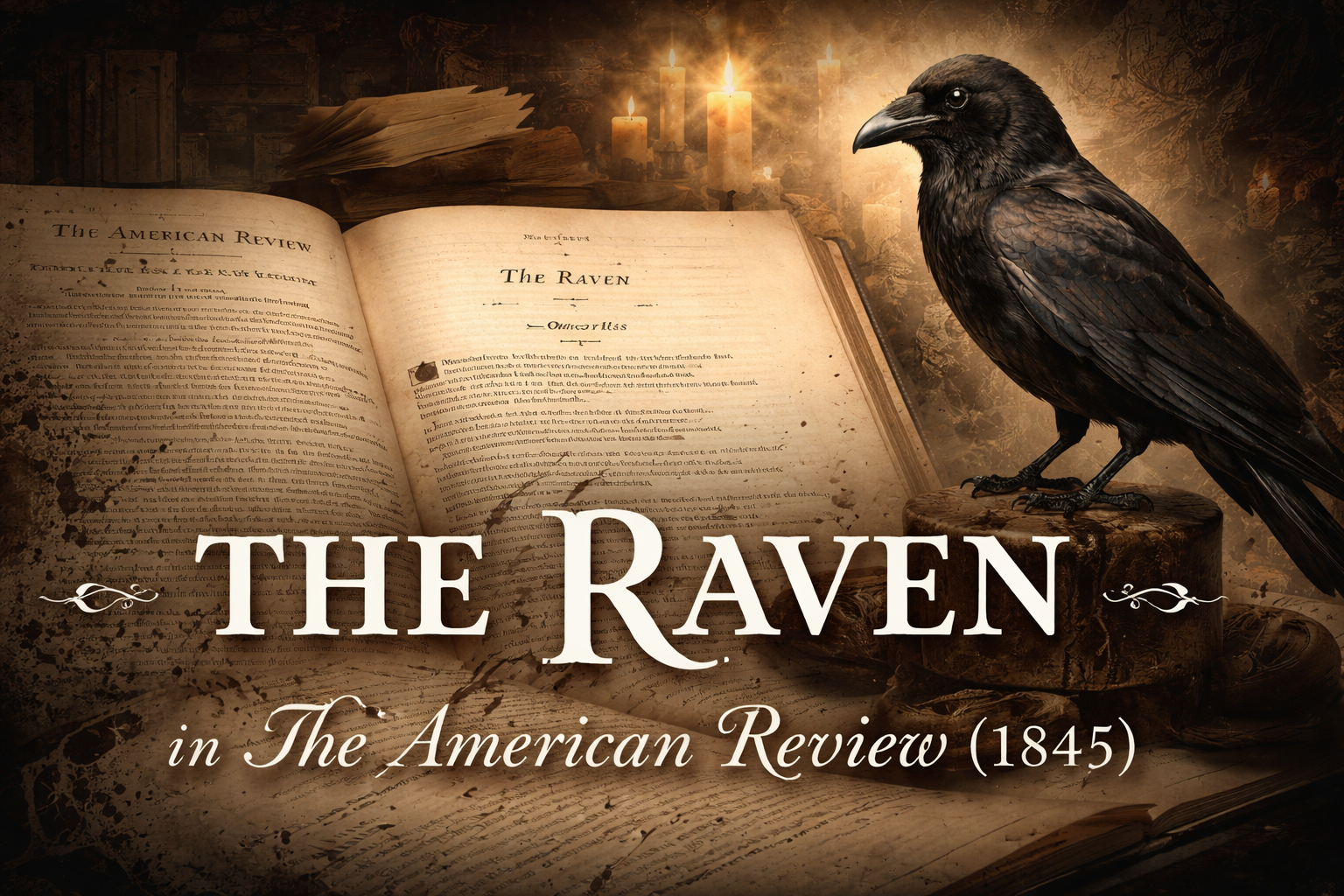
Its first formal appearance was not under the name of Edgar Allan Poe, but under the pseudonym Quarles, in the February 1845 issue of The American Review. This moment marks one of the most important publication events in American literary history: the point at which Poe’s most famous work entered the world anonymously, wrapped in editorial admiration, and poised to alter the course of his career forever.
What follows is an archival examination of that publication — its context, its presentation, its reception, and its lasting significance.
A New Journal and a Poem in Waiting
By 1845, Poe was living in New York and struggling financially, despite a growing reputation as a sharp literary critic and inventive storyteller. He had already published poems and tales in respected magazines, but none had given him lasting recognition or security. “The Raven” was written during this period of uncertainty — carefully structured, meticulously musical, and deliberately designed to linger in the reader’s mind.
At the same time, The American Review: A Whig Journal of Politics, Literature, Art, and Science had just been launched. The journal was conceived as a cultural counterweight to Democratic-leaning publications, blending political commentary with serious literary ambition. Its editor sought not merely competent verse, but work that would signal intellectual authority and aesthetic sophistication.
“The Raven” arrived at exactly the right moment.
The poem was accepted for publication, though not under Poe’s name. Instead, it appeared attributed to “——— Quarles,” a pseudonym referencing the 17th-century poet Francis Quarles. Whether this was an editorial decision or a mutual agreement remains uncertain, but the effect was immediate: the poem read as if it had emerged from an older literary tradition while simultaneously sounding entirely new.
How “The Raven” Appeared on the Page
In The American Review, “The Raven” occupies three uninterrupted pages. It is introduced by an editorial note that deserves attention in its own right.
The editor openly praises the poem as a rare example of unique rhyming, calling attention to its alliteration, internal sound patterns, and experimental use of meter. Rather than treating the poem as merely emotional or sensational, the introduction frames it as a technical achievement — a deliberate exercise in prosody that demonstrates unexplored capacities of the English language.
This framing is crucial.
From the outset, “The Raven” was presented not as a curiosity or a gothic novelty, but as a serious literary construction. Readers were invited to admire not only its atmosphere but its architecture.
The poem itself appeared without illustration. There was no raven engraving, no decorative border, no visual cue to guide interpretation. The text stood alone, forcing the reader to build the scene entirely through language: the midnight chamber, the bust of Pallas, the tapping at the door, and the bird’s relentless refrain.
Even small textual details differ slightly from later printings — period spellings, punctuation choices, and line spacing reflect the conventions of mid-19th-century magazine typography. These differences matter to archivists, because they capture the poem before it became fixed in later editions.
This is “The Raven” before it became myth.
Anonymity, Then Immediate Revelation
Although The American Review published the poem under a pseudonym, Poe ensured that his authorship did not remain hidden for long.
Before the journal officially circulated, an advance copy of the poem was shared with Nathaniel P. Willis of the Evening Mirror. On January 29, 1845, the Evening Mirror printed “The Raven” with Poe’s name attached, introducing it with extraordinary praise and calling it the most powerful example of American “fugitive poetry” yet published.
This dual publication — anonymous in a prestigious review, openly credited in a popular newspaper — created a unique effect. Literary readers encountered the poem as a technical marvel, while the general public encountered it as a sensation.
Within days, the refrain Nevermore was everywhere.
Public Reaction and the Birth of a Phenomenon
The response to “The Raven” was immediate and overwhelming.
Readers memorized it. Newspapers reprinted it. Audiences requested public recitations. The poem was discussed, debated, admired, and — almost instantly — parodied. The speed with which imitations appeared is itself evidence of how deeply the poem embedded itself in public consciousness.
What struck readers most was not merely the story, but the sound. The internal rhyme, the hypnotic repetition, the way the poem seemed to circle inward on itself — all of it made “The Raven” uniquely suited to oral performance. Poe quickly capitalized on this, giving public readings that further cemented his reputation.
For the first time in his life, Poe was famous.
Yet the irony remains stark: the poem that made him a household name earned him almost nothing financially. Like most writers of the era, Poe received a one-time payment. As “The Raven” spread across America and beyond, he watched others profit from reprinting his work while he remained in precarious circumstances.
Fame had arrived. Stability had not.
From Magazine Poem to Literary Icon
Later in 1845, Poe published The Raven and Other Poems, ensuring the poem’s permanence in book form. Over the decades that followed, “The Raven” would be reprinted countless times, translated into multiple languages, and illustrated by some of the most celebrated artists of the 19th century.
Among the most famous of these later interpretations is the 1884 illustrated edition published by Harper & Brothers, featuring dramatic plates by Gustave Doré. Doré’s towering, shadow-drenched imagery transformed the poem into a visual epic, reinforcing its status as a gothic masterpiece and ensuring its place in both literary and artistic history.
That edition represents the culmination of a journey that began quietly, decades earlier, in the pages of The American Review.
Why the American Review Printing Still Matters
Today, readers often encounter “The Raven” in standardized modern texts, divorced from the conditions of its first appearance. But the American Review version preserves something essential: the poem at the moment of its arrival.
Here, “The Raven” is:
- Anonymous
- Untethered to Poe’s public persona
- Framed as a formal experiment rather than a cultural phenomenon
This context allows us to see the poem as its first readers did — strange, arresting, technically daring, and quietly unsettling.
For archivists, collectors, and literary historians, this printing is not merely an early version. It is the threshold moment, when Poe’s most enduring creation crossed from manuscript into history.
Conclusion
When “The Raven” appeared in The American Review in 1845, it did not announce itself as a classic. It entered the world modestly, masked by a pseudonym and nestled among essays and reviews. Yet within weeks, it had reshaped Poe’s life and altered the trajectory of American poetry.
Nearly two centuries later, this first formal publication remains a foundational document — not just of Poe’s career, but of American literary culture itself.
Once the raven spoke, literature was never quite the same.
Archival Sources & Related Primary Documents
- The American Review (February 1845) — First formal publication of “The Raven,” under the pseudonym “Quarles”
- Evening Mirror (January 29, 1845) — First appearance of “The Raven” with Edgar Allan Poe’s name
- The Raven (1884) — Harper & Brothers edition, illustrated by Gustave Doré
The Raven’s journey from newspaper print to modern physical media reflects its lasting cultural presence. A contemporary spoken-word vinyl edition offers one example of how the poem continues to be preserved and re-experienced.
The fame that The Raven brought Poe in 1845 stood in stark contrast to his earlier struggles as a fiction writer. His debut collection, Tales of the Grotesque and Arabesque, had been advertised in the Washington press six years earlier and quietly offered for sale in the capital’s bookshops — only 750 copies printed, no royalties paid, and commercial failure that haunted Poe through the depression years that followed.