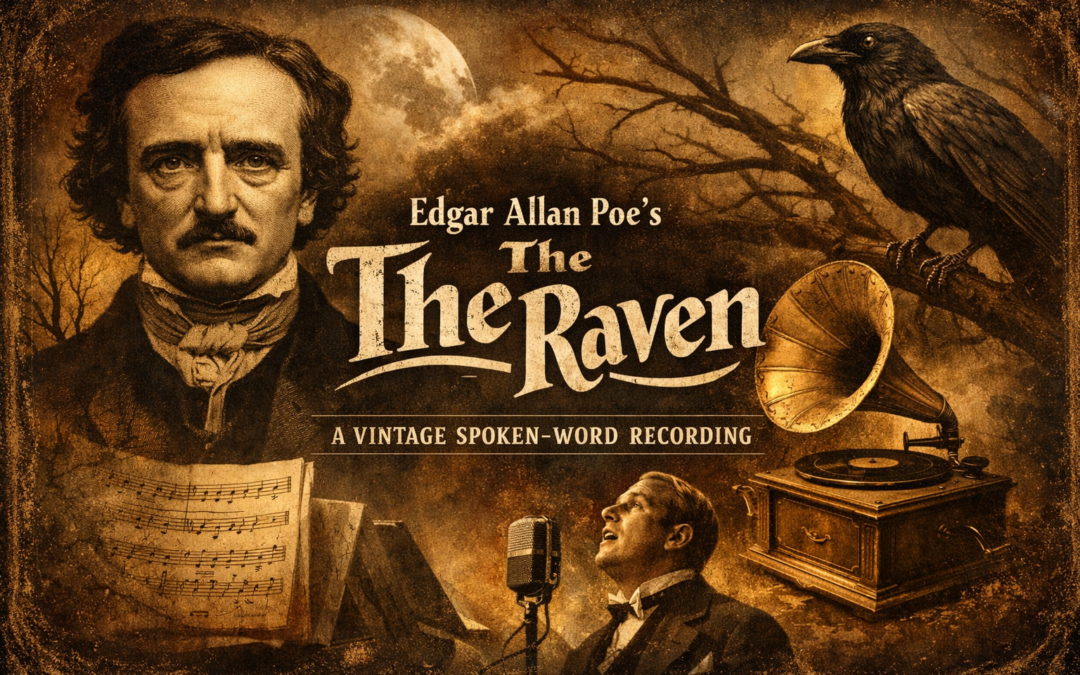
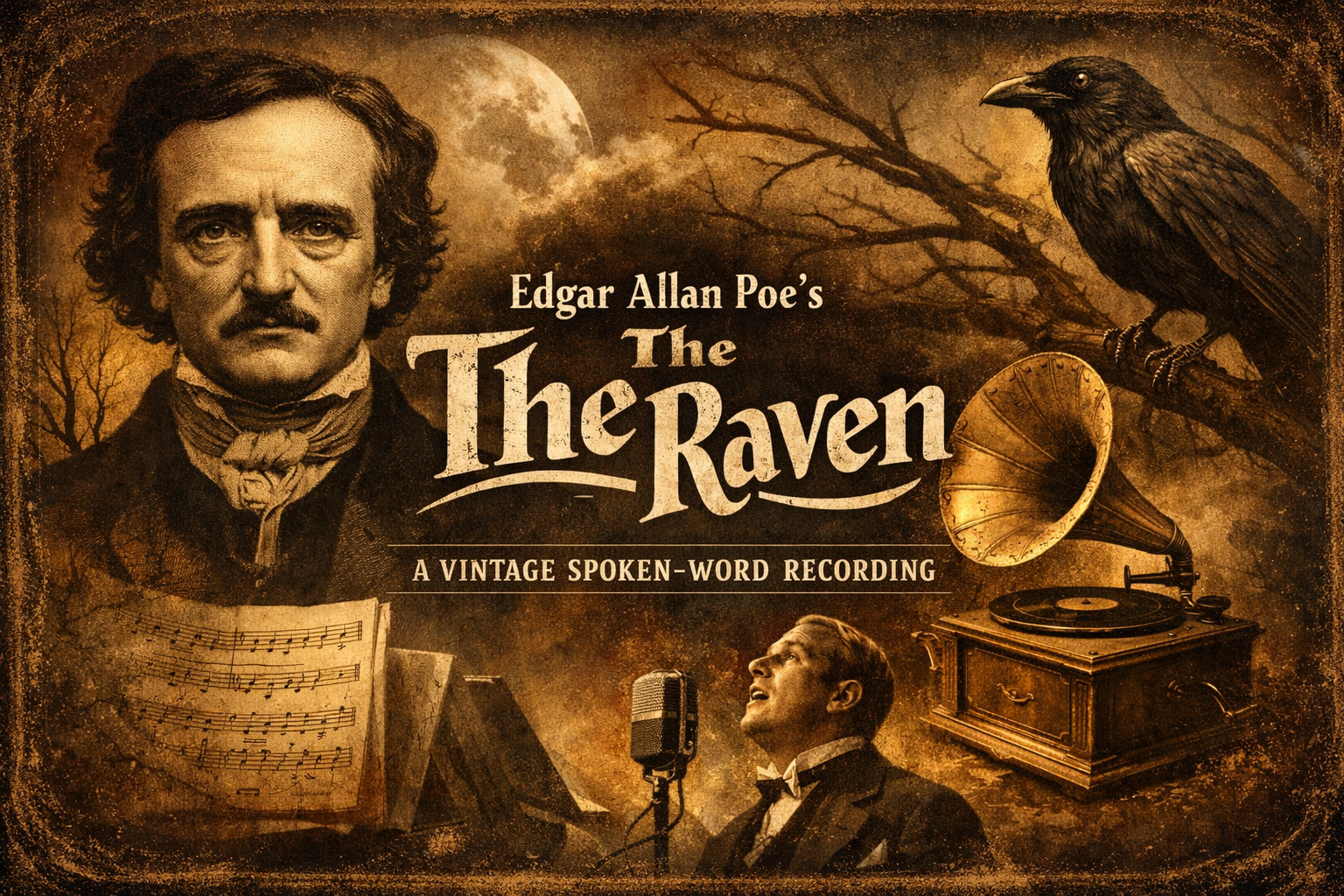
Long before Edgar Allan Poe’s The Raven became a classroom staple, a Halloween cliché, or a soundtrack to gothic aesthetics, it lived where Poe intended it to live: in the ear. The poem was engineered to be heard. Its internal rhyme, obsessive repetition, and funereal cadence were designed to circle the listener, tightening with every stanza until language itself became the mechanism of dread.
This spoken-word recording of The Raven stands as one of the earliest attempts to preserve that auditory experience in physical form. It is not a novelty record, not a theatrical parody, and not a musical adaptation in the modern sense. It is something rarer and more honest: a faithful, dramatic recitation captured at a moment when recorded sound was still learning how to carry literature.
What survives on these two sides is not just Poe’s poem, but a document of how The Raven was understood, respected, and performed in the early twentieth century — before irony, before horror fandom, before Poe became a brand.
The Poem That Demanded to Be Heard
From its first publication in 1845, The Raven was inseparable from performance. Poe himself was known to recite the poem publicly, carefully controlling tempo, emphasis, and pacing. He believed deeply in the power of sound — not merely rhyme, but effect. Every refrain, every echoing consonant, every rise and fall of the voice was part of the architecture.
Unlike many poems of its era, The Raven does not reward silent skimming. It demands time. It demands rhythm. It demands breath. A spoken-word recording, therefore, is not an adaptation — it is a restoration.
This record captures the poem as an event, not text on a page.
A Voice from the Era of Oratory
The performer on this recording is Percy Hemus, a baritone whose background in concert performance and early radio lends the recitation a gravity that feels intentional rather than theatrical.
Hemus does not rush the poem. He allows the meter to breathe. His voice carries authority without melodrama — a critical distinction. Many later recordings of The Raven lean into exaggeration, using bombast to substitute for tension. Hemus does the opposite. His restraint is what allows the dread to accumulate.
The baritone register suits the poem’s descent into obsession. As the narrator’s rational mind fractures stanza by stanza, Hemus keeps the voice grounded, letting Poe’s language do the destabilizing. This choice reflects a performance philosophy rooted in nineteenth-century elocution, where clarity, articulation, and emotional control were valued over spectacle.
It is a performance style that modern listeners may find austere — and that austerity is precisely what makes it powerful.
Music as Atmosphere, Not Distraction
Accompanying the spoken voice is piano, played with deliberate restraint. The music does not narrate the poem; it shadows it. Sparse chords, low registers, and carefully timed accents reinforce mood without intruding on language.
The incidental music attributed to Max Heinrich operates in the background like a dimly lit room — present, enclosing, but never the subject of attention. The piano performance by Gladys Craven avoids sentimentality entirely. There is no romantic swelling, no theatrical flourish. The accompaniment understands its role: to frame the voice, not compete with it.
This approach reflects a transitional moment in recording history, when engineers and performers were still discovering how music and speech could coexist on record. The result is something closer to chamber drama than song — an early experiment in what we would now call sound design.
The Physical Constraints That Shaped the Performance
This recording exists across two sides, a necessity dictated by the limitations of early discs. Unlike later long-playing formats, the performer could not rely on uninterrupted flow. Each side had to be carefully timed. Each break had to fall at a moment that would not fracture the poem’s psychological arc.
That constraint shaped the pacing. The recitation is measured, intentional, and aware of its own physical boundaries. There is a subtle tension in knowing that the poem must fit the medium — a reminder that this is not just literature, but literature translated into matter.
Collectors often speak about “hearing the room” on early recordings — the faint sense of space, the slight distance between voice and microphone. Here, that distance becomes part of the experience. The poem feels less like a performance for an audience and more like a voice speaking from another room, another time.
Listening to The Raven Without Modern Filters
One of the most striking aspects of this recording is what it does not do. There are no sound effects. No raven cries. No thunder. No exaggerated madness. The horror is entirely linguistic.
Modern adaptations often struggle with restraint. They layer atmosphere on top of atmosphere, afraid that Poe’s language alone will not hold attention. This recording trusts the poem completely. It assumes the listener is capable of patience, capable of listening, capable of unease without spectacle.
That trust is radical by contemporary standards — and deeply faithful to Poe.
A Record for Readers, Not Just Collectors
While the physical format places this firmly in the world of record collecting, its true value lies elsewhere. This is a record for readers — for those who want to understand how The Raven functioned before it became endlessly reinterpreted.
Hearing the poem delivered in this manner clarifies its architecture. The repetition of “Nevermore” becomes oppressive rather than dramatic. The internal rhymes reveal their mechanical precision. The slow tightening of the narrator’s obsession feels inevitable rather than explosive.
This is The Raven as a psychological mechanism, not a gothic caricature.
Why This Recording Still Matters
In the crowded landscape of Poe adaptations, this spoken-word record occupies a rare position. It is early enough to be close to Poe’s own century, yet preserved well enough to remain intelligible and impactful. It reflects a time when literature was treated with seriousness by performers and listeners alike — when a poem warranted the expense and effort of recording.
For anyone interested in Poe as a writer rather than a symbol, this recording is essential. It demonstrates how The Raven was meant to sound when stripped of later mythologies and modern horror tropes.
It is not definitive. No recording ever is. But it is honest, and honesty is rare in Poe’s afterlife.
Final Thoughts
This record does not attempt to modernize Poe. It does not explain him. It does not apologize for him. It simply allows The Raven to exist as sound — deliberate, controlled, and relentless.
Listening to it feels less like entertainment and more like eavesdropping on a ritual. The voice recites. The piano breathes. The poem unfolds exactly as it was designed to.
And when the final “Nevermore” falls into silence, there is no applause, no resolution — only the lingering sense that something precise and unsettling has been completed.
That, perhaps, is the truest tribute to Edgar Allan Poe.